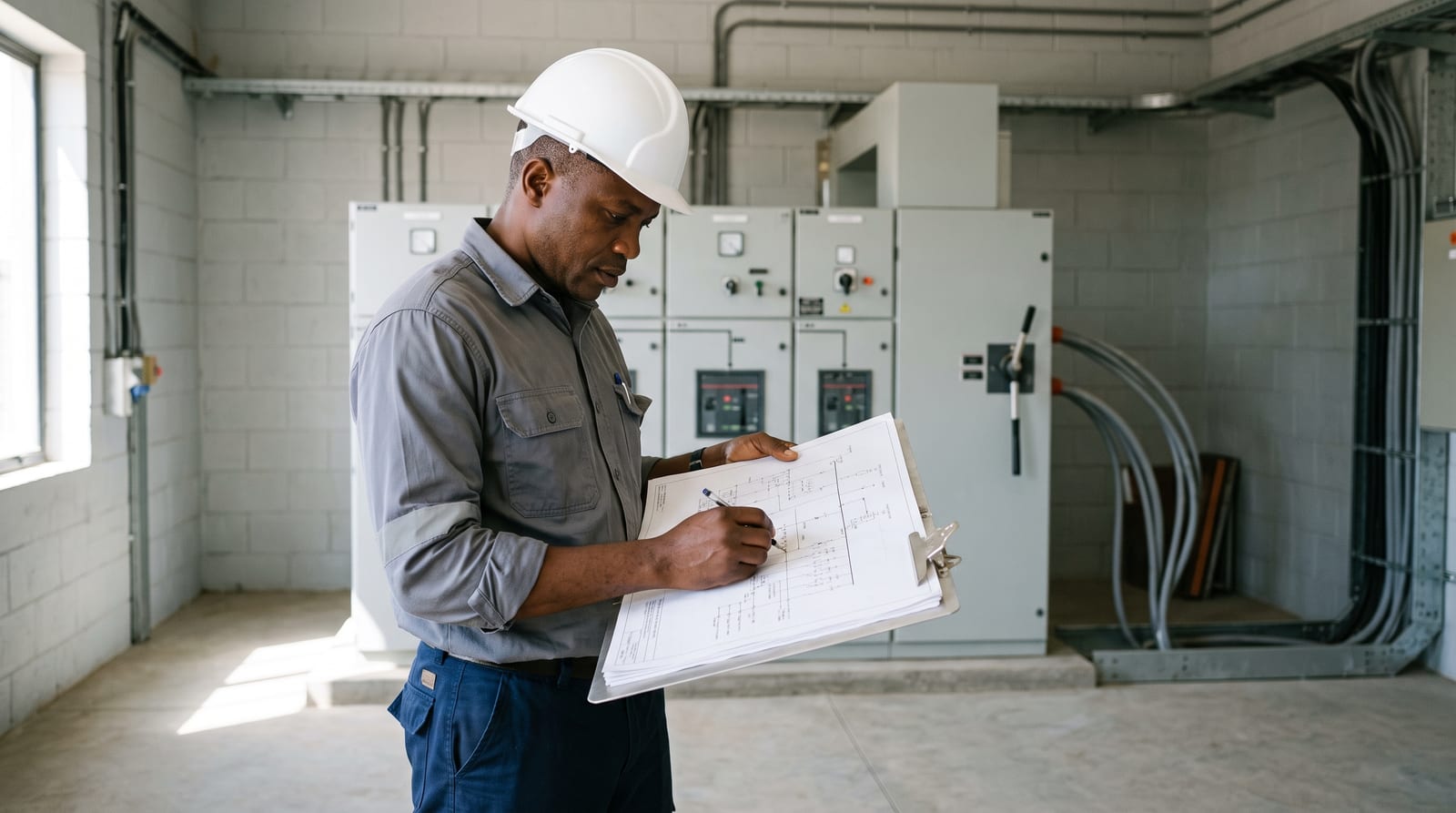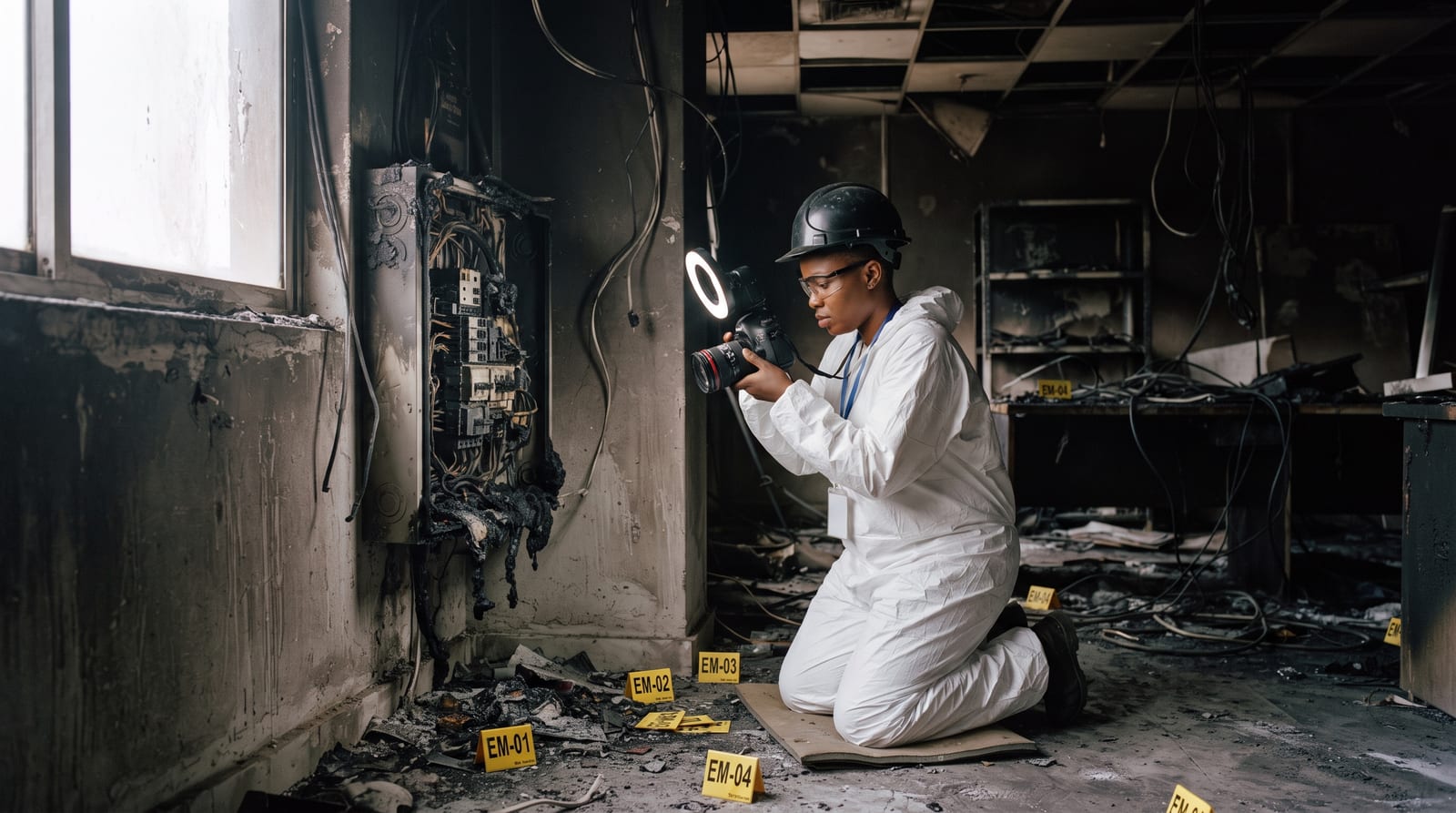
An electrical fire investigation is a structured engineering inquiry that establishes where a fire started, whether electrical energy caused it, and, if so, which component, installation defect or event was responsible. For an insurer, the answer decides whether a claim is covered, whether a third party can be pursued, and what risk improvements to require at renewal. For a lawyer, it decides whether an opinion will survive cross-examination. The recognised framework is NFPA 921, Guide for Fire and Explosion Investigations, which requires the scientific method at every step. This guide explains how that method is applied to electrical fires, why origin must be settled before cause, where arc surveys help and where they mislead, how evidence is preserved so that nobody can later claim it was spoiled, and what a defensible report contains.
What's in this guide
- What does an electrical forensic investigation establish?
- How does the scientific method apply to fire investigation?
- Why must origin be established before cause?
- What can arc surveys tell you, and what can they not?
- Which electrical failure modes are tested?
- How is evidence preserved and examined?
- What should an insurer expect in the report?
The numbers at a glance
| Item | Detail | Source |
|---|---|---|
| Governing guide | NFPA 921, Guide for Fire and Explosion Investigations | NFPA |
| Arc mapping introduced | 2001 edition | Court exhibit critique (CourtListener) |
| Arc mapping reclassified | Combined with fire patterns as one origin-determination process in the 2021 edition | NFPA |
| 2024 edition additions | Guidance on confirmation bias, opinions and expressions of certainty | NFPA 921 (2024) |
| 2025 amendment (TIA 921-24-2) | An electrical engineer is not required to conduct an arc survey; one may be needed for short-circuit calculation or circuit tracing | NFPA |
| Lithium-ion batteries | Addressed in the "Electricity and Fire" chapter | NFPA 921 (2021) |
| One published critique's estimate | ~0.7% of arced solid-conductor branch circuits allow a valid direction-of-spread conclusion | CourtListener exhibit |
What does an electrical forensic investigation establish?
It establishes three things in order: the origin (where the fire started), the cause (the heat source, the first fuel ignited, and the circumstances that brought them together), and responsibility (whether a product defect, installation error, maintenance failure or misuse created those circumstances).
When do insurers need one?
- A significant fire where the preliminary view points to electrical equipment or wiring.
- A claim where cover depends on the cause (for example, exclusions, conditions on electrical inspection, or maintenance warranties).
- A potential subrogation claim against a manufacturer, installer, contractor or landlord.
- A loss involving critical plant: transformers, switchgear, generators, UPS systems, battery banks.
- Suspicion that the fire was not accidental and an electrical explanation is being offered.
Beyond fires: other electrical losses
Electrical investigations also cover equipment failures without fire: motor and transformer burnouts, generator damage after a changeover, lightning and surge damage, and water ingress. Lobcom's investigative services include electrical, mechanical, plumbing, fire protection and fire alarm investigations, storm damage assessments and construction defect examinations for the insurance and legal communities.
Why independence matters
An investigation is only as useful as its credibility. The investigator must be independent of the installer, the equipment supplier and the parties to the claim, and must record every hypothesis considered and rejected, not only the one selected.
How does the scientific method apply to fire investigation?
NFPA 921 requires investigators to reach conclusions using the scientific method: recognise the need, define the problem, collect data, analyse the data, develop hypotheses, test them, and select a final hypothesis only when it survives testing (NFPA 921).
What does "testing a hypothesis" mean here?
It means deductive testing: asking whether each hypothesis is consistent with all the data, including witness accounts, fire patterns, electrical evidence, timelines, weather, CCTV, alarm logs and generator or meter records. A hypothesis that fails any credible data point must be revised or rejected. Testing can include calculations, laboratory examination, exemplar comparisons and, where justified, experiments.
The negative corpus problem
NFPA 921 treats "negative corpus" as inconsistent with the scientific method. That is the practice of declaring a cause because every other cause was eliminated, without positive evidence for it. An electrical cause cannot be concluded just because nothing else was found. The investigator must show evidence that the electrical component could, and did, ignite the first fuel.
Bias and certainty
The 2024 edition of NFPA 921 added guidance on confirmation bias and on how investigators express opinions and certainty (NFPA 921, 2024). In practice, a good report says what is known, what is probable, and what remains undetermined, and it treats "undetermined" as an honest result rather than a failure.
Why must origin be established before cause?
Because a cause can only be credible if it is located at the origin. An electrical fault found three metres from where the fire started is usually a victim of the fire, not its cause.
How is origin determined?
NFPA 921's origin methodology combines several data sources:
- Witness information: who saw what, where, and when.
- Fire patterns: burn depth, char, protected areas, heat and flame vectors, ventilation effects.
- Electrical evidence, including the arc survey (see the next section).
- Fire dynamics: how the fuel load, ventilation and compartment geometry would have shaped growth and spread.
The 2021 edition restructured fire pattern guidance and treated arc mapping as a form of fire pattern analysis within one origin-determination process (NFPA).
Ventilation and firefighting effects
Fire patterns can be distorted by ventilation and by firefighting. The 2024 edition incorporated guidance on how ventilation and flow paths created during firefighting can move the most intense damage away from the true origin (NFPA 921, 2024). Talking to the fire service early, and recording which doors and windows were opened and when, protects the origin analysis.
What can arc surveys tell you, and what can they not?
An arc survey (arc mapping) records where electrical arcing occurred on energised circuits during a fire, to help identify the area of origin. It can be valuable, but its limitations are widely debated, and a report that leans on it alone is vulnerable.
How an arc survey works
The investigator maps the area, traces each circuit back to its protective device, examines conductors for arc beads and arc melting, and records their positions. Because a circuit must be energised to arc, and current cannot flow beyond a severed point or a tripped breaker, the sequence of arcs along a circuit can, in some cases, indicate which part of the circuit the fire attacked first.
Who should do it?
A 2025 Tentative Interim Amendment to NFPA 921 states that an electrical engineer is not required to conduct an arc survey. It requires knowledge of the electrical system and recognition of arc melting. An electrical engineer may be needed to calculate available short-circuit current or trace circuits, and metallurgists or materials scientists may be needed to decide whether an anomaly is arc damage at all (NFPA TIA 921-24-2).
The limits
Arc beads can be confused with melting caused by fire heat alone. Circuits that were de-energised early, by a tripped breaker, a utility outage or a generator shutdown, may show no arcing near the origin at all. A critique filed as an exhibit in a US federal case argued that valid direction-of-spread conclusions can be drawn from a small minority of arced circuits, estimating about 0.7 percent for solid-conductor branch circuits, and urged NFPA to narrow the method's role (CourtListener exhibit). Whatever view one takes, the practical lesson is clear: an arc survey is one data source, to be tested against the others.
Why this matters in Nigeria
Many Nigerian buildings switch between grid, generator and inverter supply. At the moment of a fire, some circuits may have been dead because the grid was off and the generator not yet started. An arc survey interpreted without the site's supply status at that moment will mislead. Pull the changeover logs, generator hour meters, inverter event logs and DisCo outage records before interpreting arc evidence.
Which electrical failure modes are tested?
The investigator lists every credible electrical ignition mechanism at the origin and tests each against the evidence. The common candidates are these.
High-resistance connections
A loose or corroded termination heats locally, sometimes for weeks before ignition. Evidence includes localised heating damage, oxidation, pitting at contact surfaces and discoloured insulation near terminals. Poor terminations in distribution boards and at heavy loads (air conditioners, water heaters, pumps) are a recurring finding in electrical losses.
Overloaded or undersized conductors
Cables carrying more current than their rating, or installed in conditions that prevent heat dissipation (bundled, buried in insulation, run through hot plant rooms), degrade their insulation over time. Evidence includes cable sizing against protective device ratings, load records, and insulation condition along undamaged lengths.
Failed or bypassed protection
Breakers of the wrong rating, fuses replaced with wire, protective devices bypassed to stop "nuisance tripping", or residual current devices missing where required. Protection that should have cleared a fault and did not is often the key finding in responsibility.
Earthing faults
Poor or absent earthing can allow fault current to flow through unintended paths, heating metalwork and igniting nearby materials. Earth resistance tests on surviving parts of the installation and inspection of earth conductors and electrodes are standard.
Surges and supply events
Voltage surges from lightning, grid restoration after an outage or badly managed generator changeover can damage equipment and, in some cases, cause ignition. Evidence includes damage patterns across multiple unrelated appliances, surge protection device condition, and supply records.
Equipment and product defects
Appliances, UPS units, inverters, battery banks and switchgear can fail internally. NFPA 921 addresses lithium-ion batteries in its "Electricity and Fire" chapter. Product-defect conclusions usually require laboratory examination and comparison with exemplar units, and they form the basis of subrogation claims against manufacturers.
An illustrative scenario
This scenario is illustrative, not a real case. A fire damages a warehouse office. The preliminary suggestion is an air conditioner. The origin analysis, from fire patterns and witness accounts, places the origin near the distribution board, not the air conditioner. Generator logs show the site had just changed over to generator supply. Examination finds heat damage concentrated at one outgoing terminal with evidence of a long-standing loose connection, while the air conditioner shows only external fire damage. Each alternative hypothesis (air conditioner fault, lighting circuit, discarded smoking materials) is tested and rejected against specific evidence. The finding points to installation workmanship and maintenance, which changes the subrogation position entirely.
How is evidence preserved and examined?
Evidence is preserved by securing the scene, documenting before disturbing, notifying interested parties, and keeping an unbroken chain of custody. Get this wrong and the other side can argue spoliation, meaning the loss or alteration of evidence they had a right to examine.
At the scene
- Attend early, before clearance, salvage or repairs.
- Photograph systematically: exterior, each room, the origin area, and each item before and after movement.
- Sketch and measure the scene, recording the positions of electrical items, outlets, panels and cable routes.
- Record the supply status: grid, generator, inverter, solar, and the position of every breaker and switch.
- Collect records: maintenance logs, electrical inspection certificates, generator and changeover logs, CCTV, alarm panel history, meter data.
Joint examinations
Where a product or contractor may be responsible, notify the manufacturer, installer and their insurers and invite them to a joint scene examination or a joint laboratory examination. Agree protocols in advance. This protects the eventual claim from spoliation arguments.
In the laboratory
Removed items are labelled, bagged and logged with chain-of-custody records. Examination can include visual and microscopic inspection, radiography (X-ray) of damaged conductors and devices before dismantling, and comparison with exemplar products. Research published in the Journal of the National Academy of Forensic Engineers has validated X-ray imaging as a non-destructive way to characterise post-fire conductor damage (NAFE Journal).
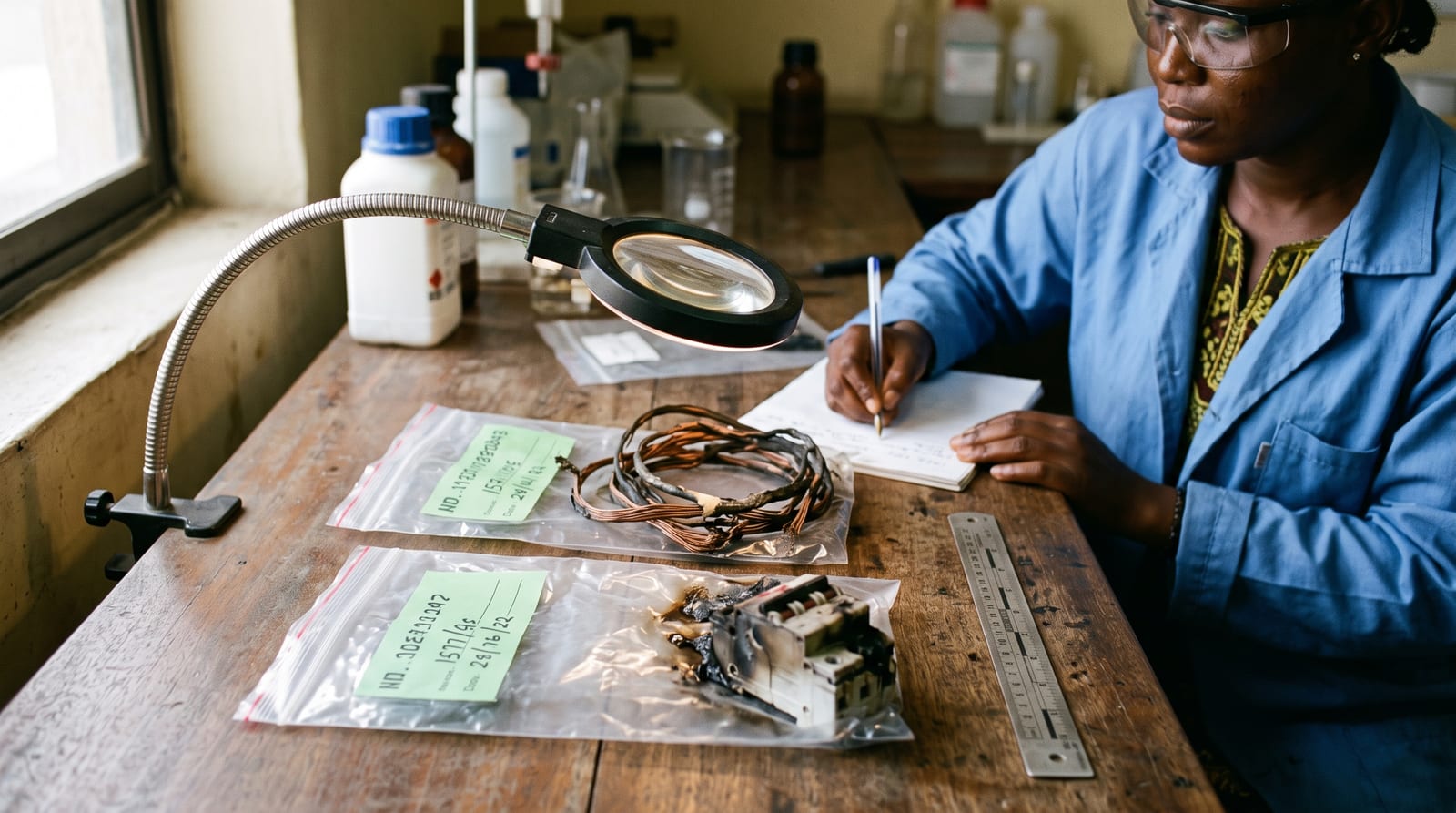 Fire-damaged conductors and a breaker in labelled evidence bags
What should an insurer expect in the report?
A defensible report sets out the method, the evidence, every hypothesis considered, the tests applied, and a conclusion stated with appropriate certainty. It should be readable by a claims manager and survive scrutiny by an opposing expert.
The core contents
- Instructions and scope: who instructed, what questions were asked, dates of attendance.
- Background: the building, occupancy, electrical installation and supply arrangements.
- Scene description and documentation: photographs, sketches, evidence log.
- Origin analysis: data sources, patterns, arc survey results and their limits, and the conclusion on origin.
- Cause analysis: each hypothesis, the evidence for and against, the tests applied, and why each was accepted or rejected.
- Responsibility: installation, maintenance, product or use factors, where the evidence supports an opinion.
- Conclusions: stated with clear certainty language, including "undetermined" where that is the honest answer.
- Recommendations: risk improvements for the insured and for the insurer's underwriting.
- Appendices: evidence log, chain of custody, laboratory results, records relied on.
Questions a claims manager should ask
- Was the origin established independently of the cause?
- Were all credible alternative causes tested and rejected with specific evidence?
- Was the supply status at the time of the fire established?
- Were interested parties notified before evidence was moved or destroyed?
- Does the certainty language match the evidence?
How the report supports underwriting
The recommendations section is often the most valuable part for the insurer's future book. Recurring findings (poor terminations, missing earthing, bypassed protection, inadequate changeover design) point to inspection conditions and risk surveys that reduce future losses across a portfolio.
Gotchas
Clearing the scene too early
Salvage and repairs destroy the origin area. Instruct the investigator before clearance.
Concluding "electrical" by elimination
Negative corpus is not accepted under NFPA 921. An electrical cause needs positive evidence.
Reading arc beads without the supply status
Circuits dead at the time of the fire cannot arc. Establish grid, generator and inverter status first.
Moving evidence without notifying other parties
This invites spoliation arguments that can defeat subrogation.
Overstating certainty
A conclusion stronger than the evidence is the easiest thing for an opposing expert to attack.
Key takeaways
- Electrical fire investigations follow NFPA 921's scientific method: every hypothesis is tested against all the data before a conclusion is reached.
- Origin must be established before cause; an electrical fault away from the origin is usually a victim of the fire.
- Arc surveys are one data source with real limitations and must be interpreted alongside the site's supply status and other evidence.
- Early attendance, systematic documentation, joint examinations and chain of custody protect the claim from spoliation arguments.
- A defensible report states its method, rejects alternatives with evidence, and uses certainty language that matches the evidence.
Frequently asked questions
How quickly should an electrical investigator attend after a fire? As soon as the scene is safe and before any clearance, salvage or repair begins.
Does an electrical engineer have to do the arc survey? Under a 2025 amendment to NFPA 921, no. An electrical engineer may still be needed for short-circuit calculations and circuit tracing, and for wider electrical analysis.
Can the cause of a fire be "undetermined"? Yes. When the evidence does not support a single cause to the required certainty, "undetermined" is the correct scientific result.
What is subrogation, and how does the investigation support it? Subrogation is the insurer's recovery of its payout from a responsible third party. An investigation that identifies a product defect or contractor error, with preserved evidence and joint examinations, is the foundation of that claim.
Do you investigate equipment failures that did not cause a fire? Yes. Transformer, switchgear, generator, motor and surge-related failures are investigated with the same method.
Related reading
- Power Factor Correction: How Nigerian Maximum Demand Customers Cut Bills
- The Hidden Leaks: 7 Things in Your Generator Room Burning Diesel Right Now
- How to Build an Independent Power Project (IPP) in Nigeria
Need an independent opinion? Lobcom provides electrical, mechanical, plumbing, fire protection and fire alarm investigations for insurers, loss adjusters and lawyers, with prompt attendance and reports built to be tested. Instruct an investigation.
Sources
- NFPA 921, Guide for Fire and Explosion Investigations (2021)
- NFPA 921 (2024 edition preview)
- NFPA TIA 921-24-2 (2025)
- Journal of the National Academy of Forensic Engineers: State of the Arc (Mapping)
- Journal of the National Academy of Forensic Engineers: X-ray examination of post-fire conductors
- CourtListener: Arc mapping critique (court exhibit)