An independent power project in Nigeria succeeds or fails before a single engine is delivered. The load study sets its size, the fuel contract sets its cost, the licence route sets its timeline, and the distribution network decides whether the power reaches the people paying for it. This guide walks through each stage in the order a project actually moves: proving the demand, securing fuel, choosing the right licence under the Electricity Act 2023 (from NERC or from one of the 16 state regulators now in charge of their own markets), engineering the plant and network, commissioning it, and keeping it running. It is written from the site, by a team that has delivered generation plants from 3MW to 8MW, feeder networks and metering across Nigeria since 2002.
What's in this guide
- What is an independent power project, and who is building them now?
- Stage 1: How do you size an IPP correctly?
- Stage 2: Where will the fuel come from?
- Stage 3: Which licence or permit does your IPP need?
- Stage 4: What does the engineering design cover?
- Stage 5: How is the distribution network built?
- Stage 6: What happens at testing and commissioning?
- Stage 7: How do you keep an IPP bankable after handover?
The numbers at a glance
| Figure | Value | Source |
|---|---|---|
| Grid plant availability, April 2026 | 31% (4,286MW of 13,625MW installed) | NERC via EBC Financial Group |
| Average available grid generation, Q1 2026 | 4,457.96MW, down 17.45% on Q4 2025 | NERC 2026 Q1 Report |
| Manufacturers' spend on self-generation, 2025 | ₦1.34 trillion | Manufacturers Association of Nigeria |
| Captive generation permit threshold | Above 1MW for own use | NERC Captive Power Generation Regulation |
| Embedded generation classes | >1–6MW at 11kV; >6–20MW at 33kV | NERC Embedded Generation Regulations 2012 |
| Mini-grid ceiling (2026 regulations) | Isolated up to 5MW; interconnected up to 10MW per site | NERC Mini-Grid Regulations 2026 |
| NERC licence processing timeline | Up to 6 months from complete application | NERC licensing page |
| States with transferred regulatory oversight | 16 | BusinessDay, July 2026 |
What is an independent power project, and who is building them now?
An independent power project (IPP) is a generation plant, usually with its own distribution network, owned and operated outside the national grid's public utility structure to supply a defined customer or group of customers. In Nigeria the term covers everything from a 1MW gas plant behind a factory fence to a multi-megawatt station feeding a university campus, an estate or an industrial cluster.
Why are more Nigerian organisations building their own power?
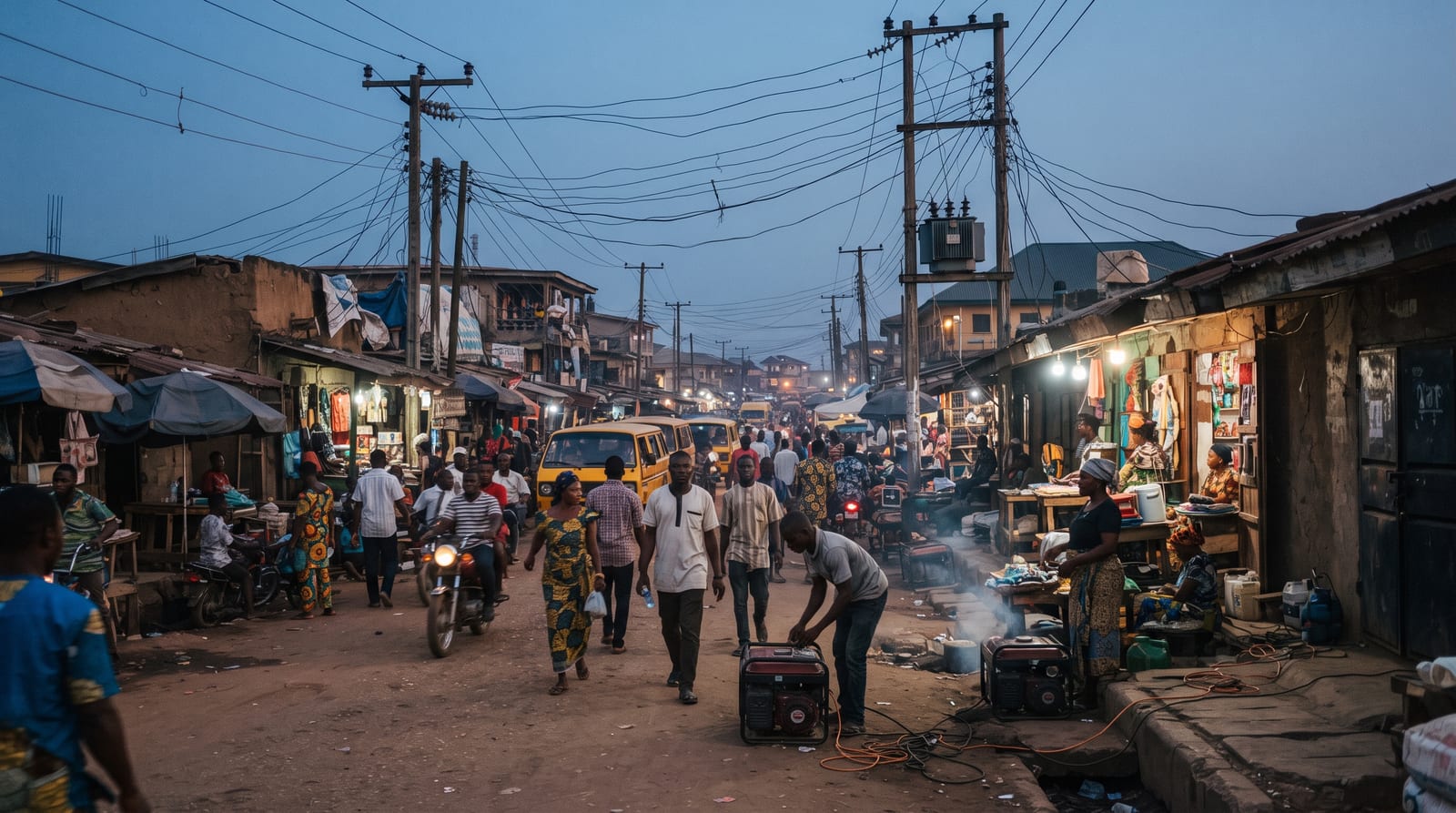
Because the grid is not delivering what it is paid for. NERC's April 2026 factsheet put grid plant availability at 31 percent: about 4,286MW available out of 13,625MW installed (EBC Financial Group). The Manufacturers Association of Nigeria (MAN) reported that average daily supply to its members fell from 16.7 hours in the first half of 2025 to 13.1 hours in the second half (Africa Business Insight). Manufacturers spent ₦1.34 trillion generating their own power in 2025, and MAN says first-half 2026 spending had already matched that figure (The Frontier).
What changed in the law?
The Electricity Act 2023 removed electricity from the Exclusive Legislative List, allowing states to regulate generation, distribution and supply within their borders. Sixteen states have completed the transfer of regulatory oversight, and NERC keeps interstate, grid and standards matters (BusinessDay). For a project developer, the practical meaning is that your regulator depends on where your electrons start and finish. More on that in Stage 3.
Who is actually building IPPs?
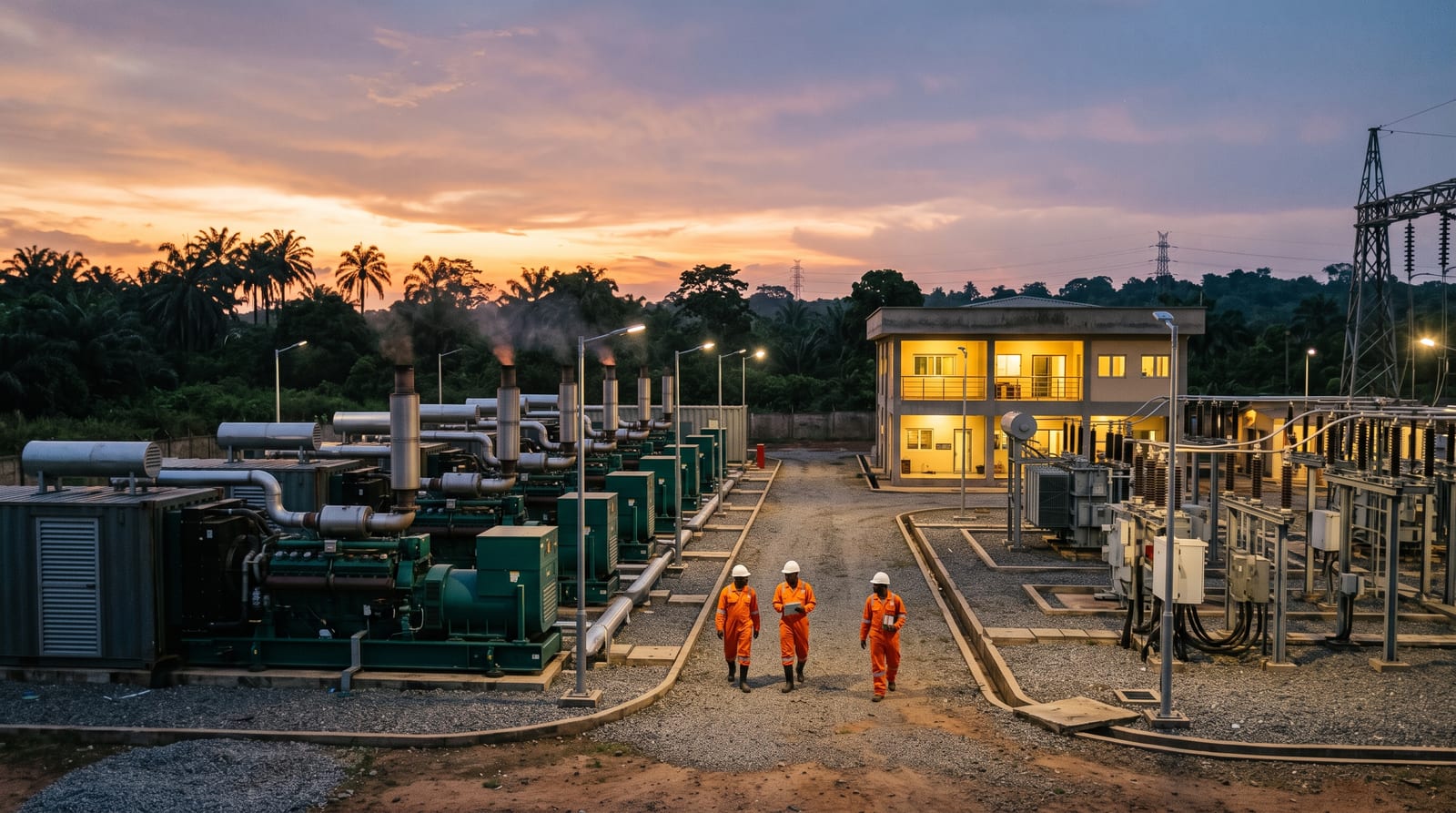
Large manufacturers already run substantial captive plants. NERC-listed examples include Flour Mills of Nigeria (70MW) and Lafarge Cement WAPCO (90MW) (Africa Business Insight). The newer wave is mid-sized: universities, private estates, hospitals, industrial clusters and state-backed projects in the 3–10MW range. That is the band where Lobcom works most. Our delivered plants include an 8MW plant at Sagamu and a 6MW plant at Apapa for Uraga Power (Honeywell Group), the 5MW Ekiti IPP with its distribution network, and a 4MW university IPP with an 11km underground network and advanced metering.
Stage 1: How do you size an IPP correctly?
You size an IPP from measured load, not from the sum of nameplate ratings. The most expensive mistake in captive power is a plant that is too big: engines running at low load burn more fuel per kilowatt-hour, wear faster and destroy the business case.
What does a proper load study measure?
A load study logs real demand at the incoming supply and at major sub-boards, ideally for at least two to four weeks that include both peak and quiet periods. It captures:
- Peak demand (kW and kVA) and when it happens.
- Base load, the demand that never switches off (cold rooms, servers, water pumping, security lighting).
- Load factor, meaning average demand divided by peak. A low load factor means your plant will spend most of its life part-loaded.
- Power factor, because generators and transformers are rated in kVA, and poor power factor forces you to buy capacity you cannot use.
- Motor starting currents, which decide whether the engines can pick up large compressors, chillers or crushers without voltage collapse.
How much should you plan for growth?
Plan for growth in phases rather than in steel. A campus that expects to double its student population over ten years should design the switchgear, building, fuel system and cable routes for the final size, but install engines in blocks as demand arrives. Modular gas engines make this straightforward. Each added unit also improves redundancy: with N+1 configuration, one engine can be out for maintenance without shedding load.
What does the feasibility study decide?
The feasibility study turns load data into a go/no-go decision. It compares the options (grid plus backup, captive gas plant, hybrid gas and solar, interconnected mini-grid), prices each one over 10–15 years, and tests the sensitivity to fuel price, exchange rate and utilisation. A useful feasibility study also answers the uncomfortable questions: what happens if gas supply is interrupted, who operates the plant at 3am, and where the money for the first major overhaul comes from.
Stage 2: Where will the fuel come from?
The fuel decision sets roughly two-thirds of your lifetime cost, so it comes before engine selection, not after. For most Nigerian IPPs the realistic choice is between pipeline gas, trucked compressed natural gas (CNG), diesel, or a hybrid with solar.
Why is gas the default for new IPPs?
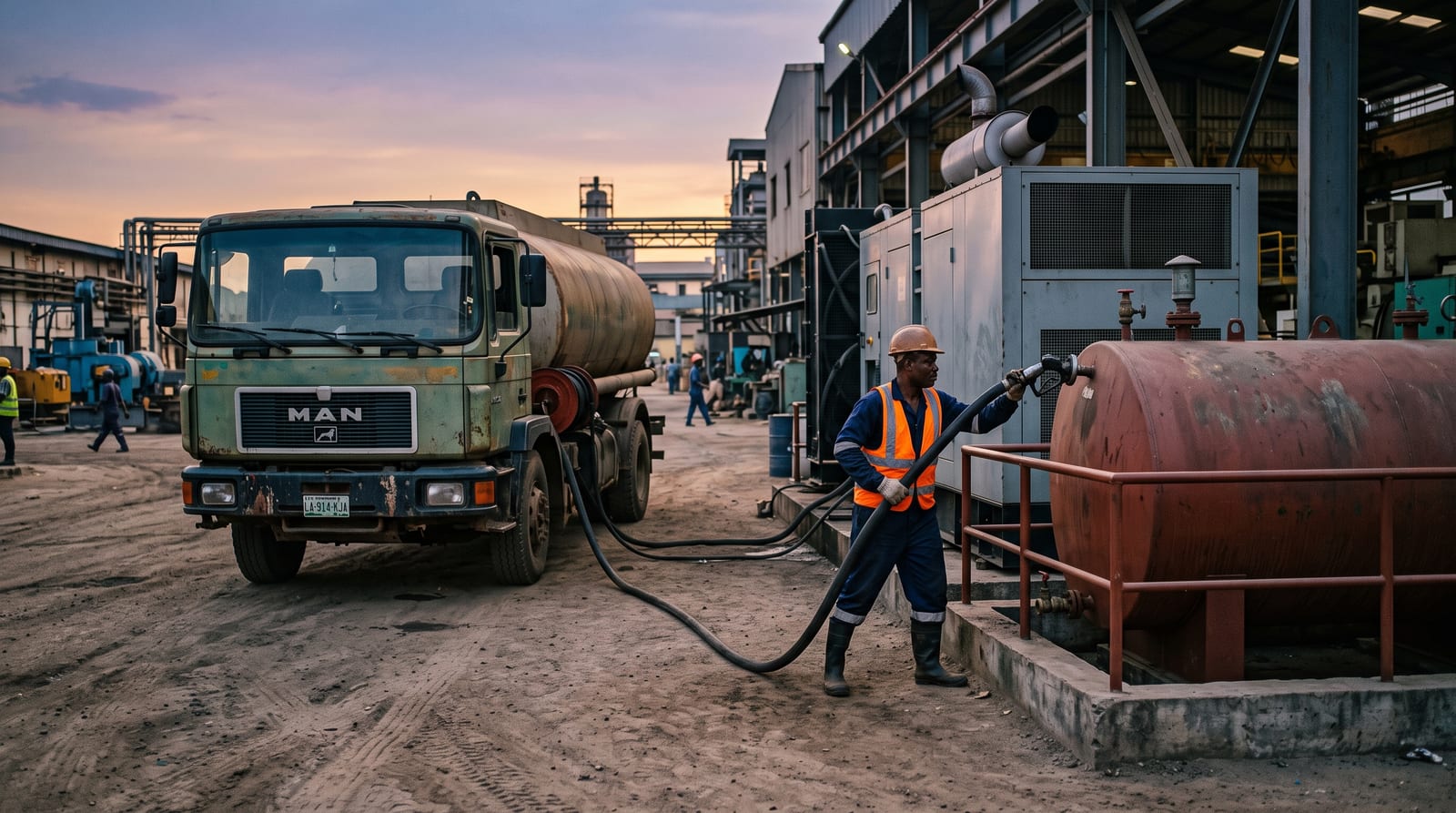
Diesel has become punishing. Prices reached about ₦2,100 per litre in Lagos and Ogun in September 2026, up from ₦1,700–₦1,800 days earlier, according to reporting by The Guardian cited in The Frontier. MAN says power now takes more than 50 percent of members' production costs. Federal policy is pushing the other way: the government is expanding CNG infrastructure under the Midstream and Downstream Gas Infrastructure Fund (State House), and the Power Minister has said the diesel era for manufacturers is ending (BusinessDay). Our companion guide, Gas vs Diesel Generators: A Total Cost of Ownership Model, works the numbers in detail.
Pipeline gas or trucked CNG?
Pipeline gas is the cheapest per unit where a network exists. PowerGas Nigeria told the Delta State investment summit that more than 20 factories in the state rely on its gas supply to generate their own power (ThisDay). Where there is no pipeline, virtual pipelines (CNG trucked in tube skids) fill the gap at a higher delivered price. The station design changes with the choice: CNG needs a pressure-reduction and metering skid, secure trailer bays and a buffer for delivery delays. Lobcom's work on the HBM gas compression station in Calabar gave our team direct experience of the compression, drying and dispensing side of that supply chain.
What should the gas supply agreement cover?
At minimum: daily and hourly contracted quantity, gas quality specification, price and indexation formula, take-or-pay terms, interruption remedies, metering and custody transfer point, and the notice period for planned outages. Lenders will read this document more closely than any other. A plant with a weak fuel contract is a plant nobody will finance.
Stage 3: Which licence or permit does your IPP need?
The licence depends on three things: how big the plant is, whether you consume the power yourself or sell it, and whether it connects to a DisCo network. Our guide Captive, Embedded or Mini-Grid? goes deeper; this section gives the map.
Captive generation permit
Captive generation is generation above 1MW consumed by the generator itself and not sold to a third party, under NERC's Regulation for Captive Power Generation. A permit holder needs NERC's prior written consent to supply surplus power up to 1MW to an off-taker; supplying more than 1MW requires a generation licence. The permit is unit- and location-specific, so moving or changing engines means amending it.
Embedded generation licence
If your plant connects to and sells through a DisCo's distribution network, it is embedded generation. The Embedded Generation Regulations 2012 classify units above 1MW up to 6MW as connecting at 11kV, and above 6MW up to 20MW at 33kV. Units above 5MW must comply with the Grid Code. NERC's licensing page lists the documents required: draft power purchase, connection, use-of-distribution-system, ancillary services and fuel supply agreements, an EIA approval for plants of 10MW and above (or an effluent management policy below 10MW), title deed and corporate documents. Processing can take up to six months from a complete application.
Mini-grid permit
NERC's Mini-Grid Regulations 2026 cover isolated mini-grids up to 5MW per site and interconnected mini-grids up to 10MW per site. Interconnected mini-grids above 1MW must submit a System Impact Study and sign a tripartite agreement with the DisCo. For campuses and estates that want to buy some power from the DisCo and generate the rest, this is often the cleanest route.
NERC or the state regulator?
Follow the electrons. If generation, distribution and supply begin and end within one state that has completed its transfer, the State Electricity Regulatory Commission (SERC) is your regulator. If power crosses a state border or involves the national grid interface, NERC remains in charge. Technical standards for equipment and meters remain federal, enforced by NEMSA (BusinessDay). The Senate's proposed Electricity Act (Amendment) Bill 2026 has drawn objections from 16 state regulators (Punch), so confirm your regulator at the start of the project and again before financial close.
Stage 4: What does the engineering design cover?
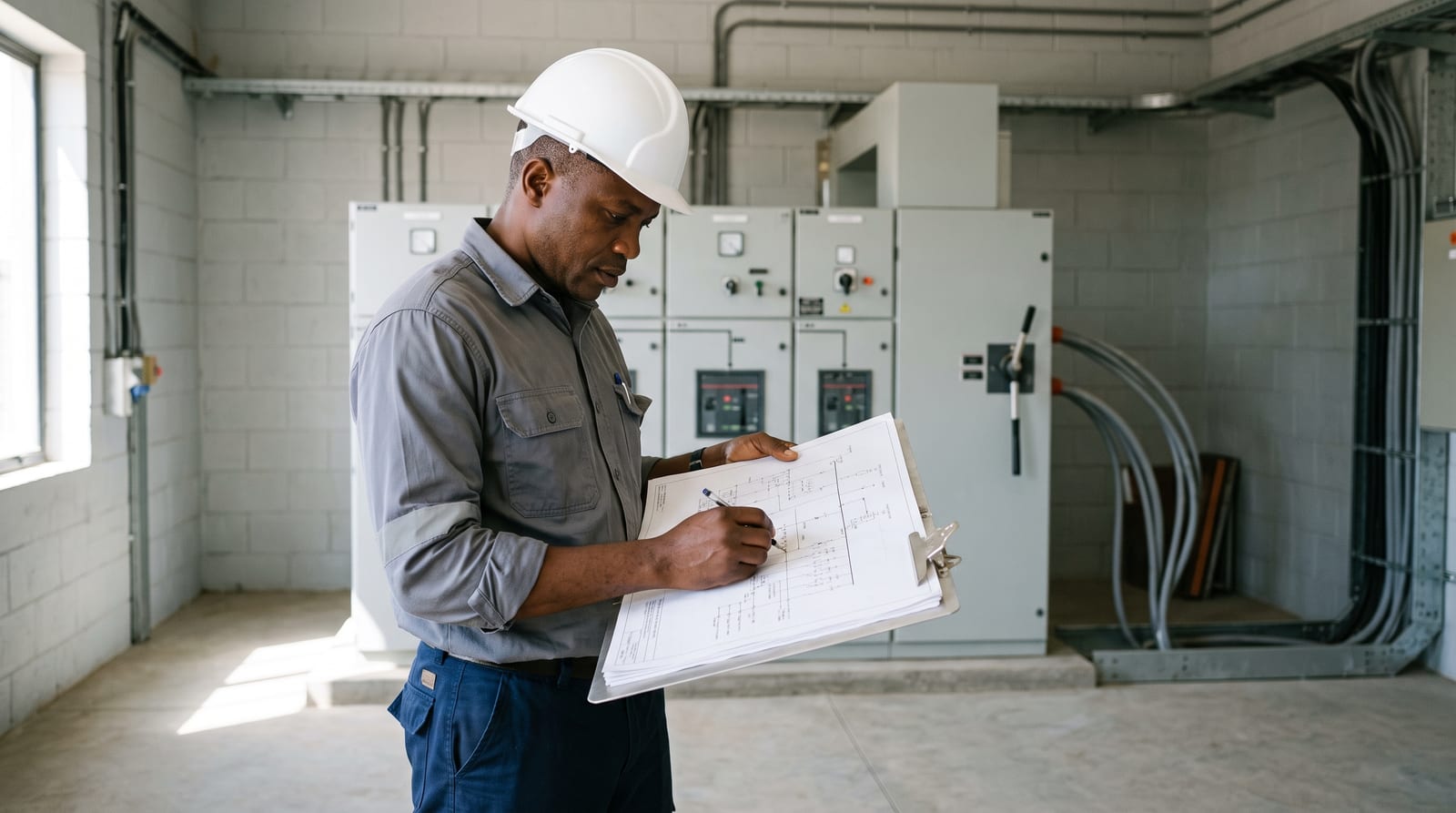
Design turns the feasibility study into drawings a contractor can build and a regulator can approve. It must cover the plant, the protection scheme, the building and the interfaces, not only the engines.
What are the core design deliverables?
- Single-line diagram (SLD) showing generators, step-up transformers, switchgear, busbars, feeders and metering points.
- Protection philosophy and coordination study, so that a fault on one feeder trips that feeder and nothing else.
- Short-circuit and load-flow studies, which size the switchgear and prove voltage stays within limits at the far end of the network.
- Earthing design for the plant, substations and every metal structure people can touch.
- Synchronisation and load-sharing logic, especially where the plant will run in parallel with the DisCo supply or with solar.
- Plant room design: ventilation and combustion air, exhaust routing, acoustic attenuation, fuel or gas train layout, fire detection and suppression.
How should the control system be specified?
Specify remote monitoring from day one. A SCADA or IoT monitoring layer that logs engine hours, load, fuel or gas consumption, alarms and feeder energy lets you manage the plant on data rather than on the night operator's memory. It also produces the operating records lenders and insurers ask for. Lobcom's metering and data-acquisition work exists because clients found that a plant without data is a plant nobody can prove is performing.
What building and civil works are often forgotten?
Cable trench routes, drainage around the engine hall, oil interceptors, bunding for fuel tanks, lightning protection, security fencing for substations, and access for a crane to lift an engine out for overhaul. These items rarely appear in early budgets and often cause the first variation order.
Stage 5: How is the distribution network built?
The network is what turns a power plant into a power supply. On many projects the generation plant takes the headlines, but the network takes more of the construction time and causes more of the faults.
Overhead or underground?
Overhead lines cost less to build and are easier to fault-find. Underground cables cost more but are protected from storms, vehicle strikes and, critically in Nigeria, cable theft and vandalism. On campuses and high-value estates, underground is often the better lifetime decision. Our Ekiti IPP network and our university project with 11km of underground cable both used buried medium-voltage cable with packaged substations. Our guide Underground vs Overhead Distribution Networks compares the two in detail.
What does a typical network include?
- Medium-voltage feeders (11kV or 33kV) from the plant switchgear.
- Ring main units (RMUs), so a cable fault can be isolated and supply restored from the other side of the ring.
- Distribution transformers or packaged substations sized to each load cluster.
- Low-voltage feeder pillars and service cables to each building.
- Metering at every point where energy changes hands or needs to be accounted for.
Why does metering belong in the network design, not after it?
Because an IPP that cannot measure what each building uses cannot bill, cannot find losses, and cannot tell when a meter is being bypassed. Design metering at three levels: generation output, feeder energy, and customer or building consumption. The difference between the first and the sum of the last is your loss figure, and it is the first number investors ask about. See our guide Smart Metering for Estates and Universities.
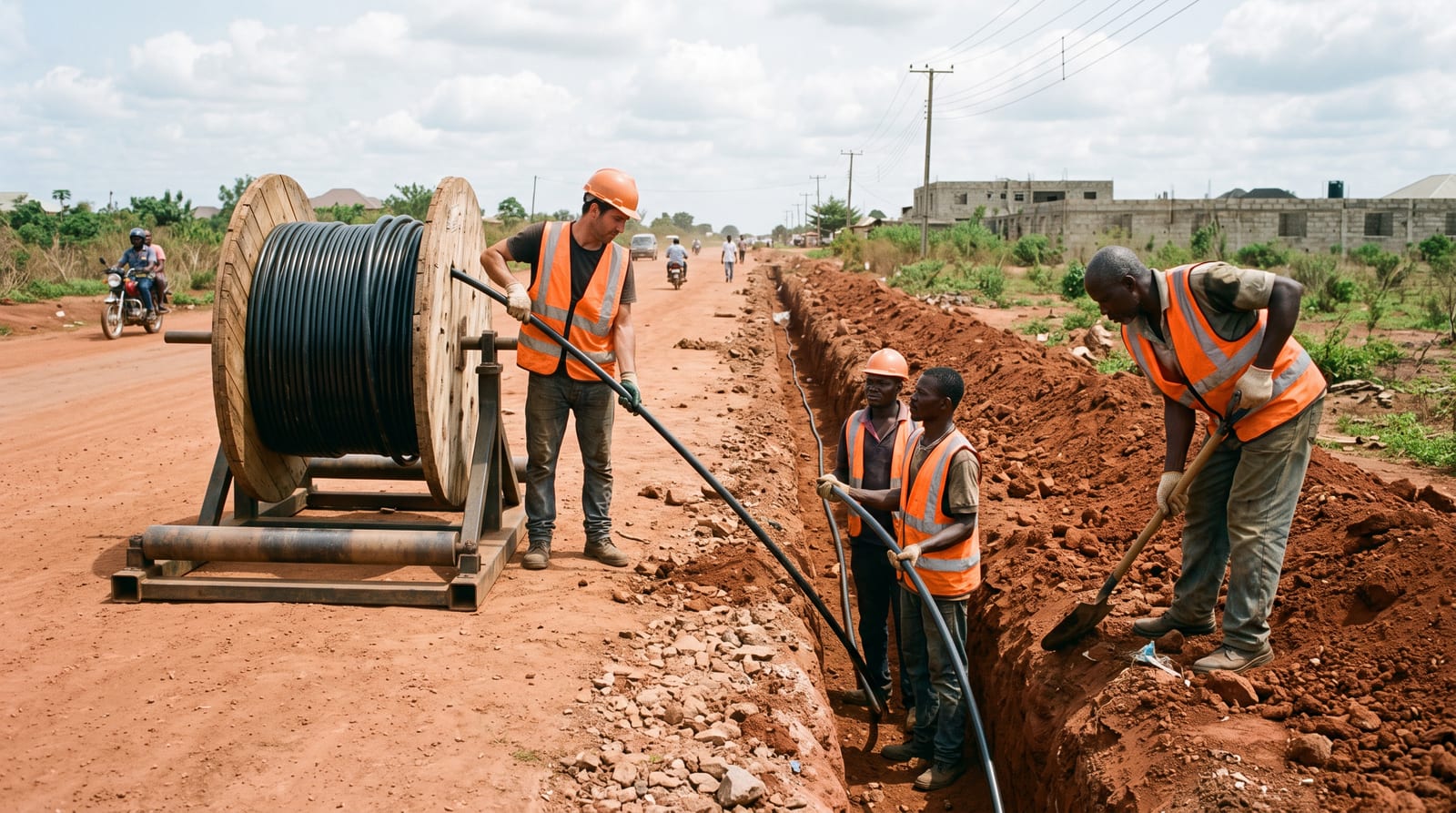 Crew laying medium-voltage underground cable into a trench
Stage 6: What happens at testing and commissioning?
Commissioning is the process of proving, with documented tests, that every system works as designed before the owner accepts it. On an IPP it runs from individual component checks to a full load test of the plant and network together.
What are the commissioning stages?
- Pre-commissioning checks: insulation resistance, cable continuity, torque checks on terminations, transformer oil tests, earth resistance measurements.
- Cold commissioning: control wiring checks, protection relay injection testing, interlock verification, alarm and trip simulations.
- Hot commissioning: engines started, run up, synchronised; load bank tests at stepped loads; protection tested under live conditions.
- Network energisation: feeders energised in sequence, phase rotation confirmed at every substation, transformer no-load and load checks.
- Performance and reliability run: the plant carries real load for an agreed period while fuel consumption, output and availability are recorded against guarantees.
What documents should the owner receive?
As-built drawings, test certificates for every item, protection settings, the O&M manuals, spare parts list, training records for operators, and the NEMSA inspection certificate where required. Do not release final payment against an incomplete handover pack. The pack is what your next contractor, your insurer and your regulator will ask for.
Stage 7: How do you keep an IPP bankable after handover?
An IPP stays bankable when it produces the availability, efficiency and records promised in the business case, year after year. That is an operations discipline, not an engineering one.
What does a sound O&M structure look like?
A written maintenance schedule tied to engine hours, a stock of critical spares on site, trained operators on every shift, a clear escalation path for faults, and monthly performance reports showing availability, energy generated, fuel or gas consumed per kWh, and losses on the network. Lobcom offers maintenance contracts, client staff training and technical support for exactly this reason: the plant we commission is judged on how it runs in year five.
Which numbers should the board see every month?
- Plant availability (hours available divided by hours in the period).
- Specific fuel consumption (litres or standard cubic metres per kWh).
- Energy generated versus energy billed or accounted for.
- Unplanned outages, their causes and their duration.
- Maintenance backlog and upcoming major overhauls.
If any of these drift, the fix is usually cheap when caught early and expensive when found at the annual audit.
Gotchas
Oversizing the plant
A plant sized to nameplate totals runs part-loaded for years, burning more fuel per kWh and wearing faster. Size from logged demand and add capacity in modules.
Signing the fuel contract last
Engines ordered before the gas agreement is settled often end up running on expensive trucked supply or diesel. Fuel terms come first.
Assuming NERC is your regulator
In the 16 states with transferred oversight, intrastate projects answer to the state regulator. Confirm this at feasibility and again before financial close.
Treating metering as an afterthought
Without metering at generation, feeder and customer level, losses are invisible and billing is disputed. Design it into the network.
Accepting handover without the document pack
Missing test certificates and as-built drawings make every future fault, insurance claim and regulatory inspection harder and more expensive.
Key takeaways
- An IPP's economics are set by its load study and fuel contract before any equipment is bought.
- Captive generation above 1MW for own use needs a NERC captive permit; selling power through a DisCo network needs an embedded generation licence; mini-grids now go up to 5MW isolated and 10MW interconnected under the 2026 regulations.
- In the 16 states with transferred oversight, intrastate projects are regulated by the state, while standards and grid interfaces remain federal.
- The distribution network and its metering decide whether generated power becomes billed, reliable supply.
- A plant stays bankable only if it produces monthly evidence of availability, efficiency and losses.
Frequently asked questions
How long does it take to build an IPP in Nigeria? Licensing alone can take up to six months from a complete application for a NERC generation licence. Engineering, procurement and construction for a 3–8MW gas plant with its network runs alongside and after that. Timelines depend on equipment lead times, gas supply readiness and site works.
Do I need a licence for a 1MW generator at my factory? Captive generation for your own use requires a NERC permit when it exceeds 1MW. At or below 1MW for own use, the captive permit regime does not apply, although equipment standards, safety and environmental rules still do. Check with your state regulator if your state has transferred oversight.
Can my IPP sell surplus power to neighbours? A captive permit holder needs NERC's prior written consent to sell surplus up to 1MW to an off-taker, and a generation licence to sell more than 1MW. In states with their own regulators, intrastate sales fall under the state framework.
Is gas always cheaper than diesel for an IPP? On current Nigerian prices gas usually wins on running cost, but the answer depends on the delivered gas price, supply reliability and how many hours the plant runs. Model both over the plant's life before deciding.
What is the role of NEMSA? The Nigerian Electricity Management Services Agency enforces technical and safety standards and inspects installations. Its inspection certificate is part of the commissioning and handover record.
Related reading
- Captive, Embedded or Mini-Grid? Which NERC Licence or Permit Your Facility Needs
- Gas vs Diesel Generators: A Total Cost of Ownership Model for Nigerian Factories
- Smart Metering for Estates and Universities
Planning a plant? Lobcom's power team runs load studies, feasibility and licensing support, and delivers design, construction, metering and commissioning under one contract. Start a project.
Sources
- EBC Financial Group: Band A credits and net billing
- Africa Business Insight: Manufacturers spend US$930m on alternative power
- The Frontier: Diesel crosses ₦2,000/litre
- NERC 2026 Q1 Report
- NERC Regulation for Captive Power Generation
- NERC Embedded Generation Regulations 2012
- NERC Generation Licence page
- NERC Mini-Grid Regulations 2026
- BusinessDay: NERC, SERCs and the regulatory turf war
- Punch: States kick as Senate moves to amend Electricity Act
- ThisDay: Delta unveils roadmap to unlock 3,000MW
- State House: MDGIF CNG projects
- BusinessDay: End of diesel generator nears for manufacturers