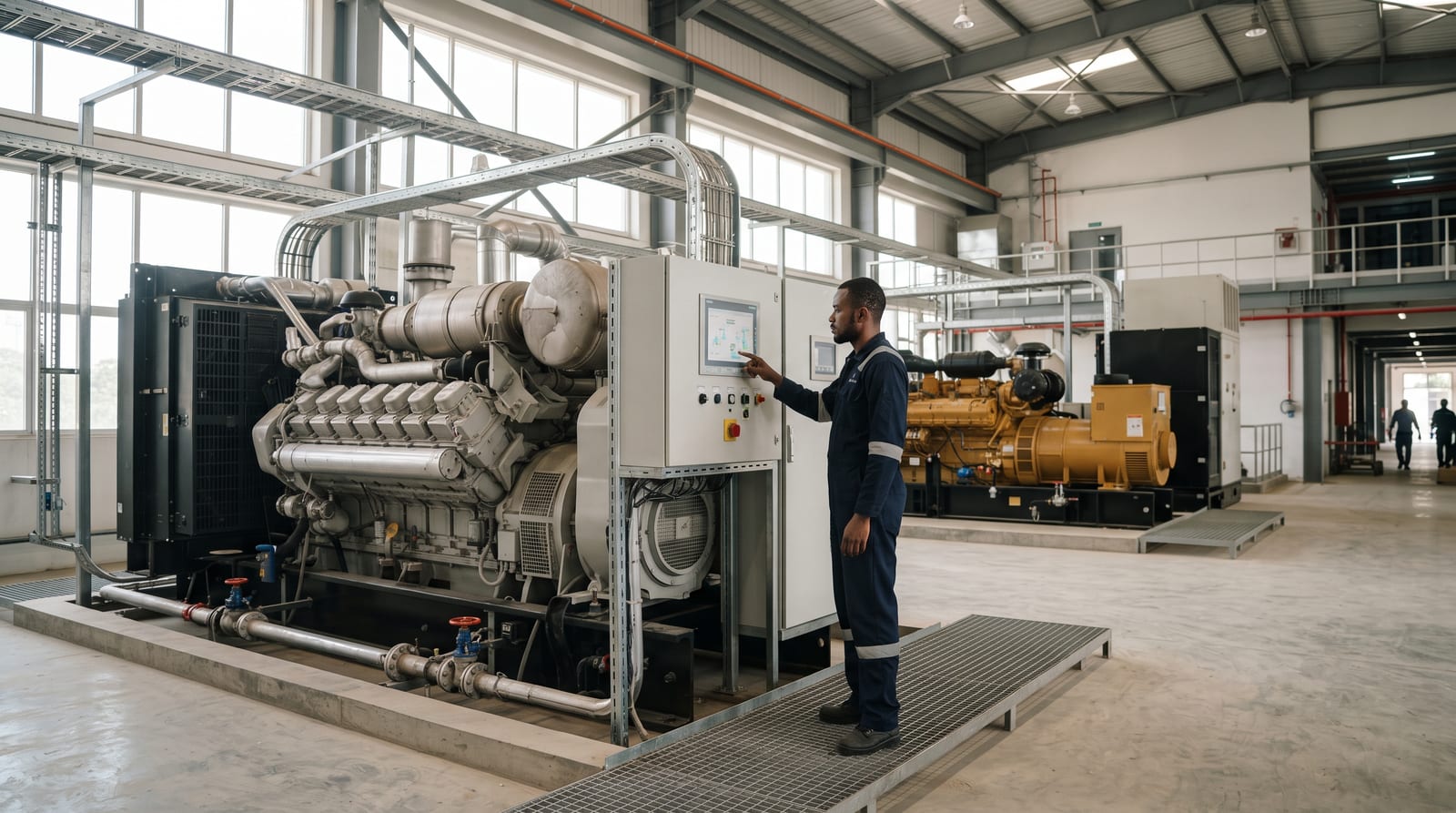
At September 2026 diesel prices, a diesel generator spends roughly ₦630 on fuel for every kilowatt-hour it produces. A gas engine only beats that if gas is cheap enough, supply is reliable enough, and the plant runs enough hours to repay its higher purchase price. This guide builds a total cost of ownership (TCO) model you can run with your own figures. It covers the fuel arithmetic behind cost per kWh, the break-even gas price above which diesel wins, the capital, maintenance and supply-risk costs that fuel-only comparisons leave out, the bi-fuel conversion option for existing diesel fleets, and a worked example for a factory with 1MW of average load. Every assumption is labelled, so you can replace ours with yours.
What's in this guide
- What does "total cost of ownership" include for a generator?
- How much does a diesel generator cost per kWh in 2026?
- How much does a gas generator cost per kWh?
- What is the break-even gas price?
- What costs do fuel-only comparisons miss?
- Should you convert existing diesel sets to bi-fuel?
- Worked example: a factory with 1MW average load
The numbers at a glance
| Input or result | Value | Basis |
|---|---|---|
| Diesel price, Lagos/Ogun, Sept 2026 | ~₦2,100 per litre | The Frontier, citing The Guardian |
| Diesel specific fuel consumption at ~75% load | 0.28–0.40 L/kWh (we use 0.30) | Published generator ranges; our assumption |
| Diesel fuel cost per kWh | ~₦630 (₦2,100 × 0.30) | Calculated |
| Natural gas energy content | ~11.1 kWh per m³ (gross) | DEFRA/DESNZ 2026 factors |
| Gas engine electrical efficiency | ~38% (our assumption for a modern engine at good load) | Assumption |
| Gas consumption | ~0.24 m³ per kWh | Calculated from the two lines above |
| Break-even gas price vs diesel fuel | ~₦2,625 per m³ | Calculated |
| Band A grid tariff | ₦209.5/kWh | NERC via Opaindex |
| Manufacturers' power share of production cost | Over 50% | MAN via The Frontier |
What does "total cost of ownership" include for a generator?
Total cost of ownership is every naira a generator costs over its working life, divided across the kilowatt-hours it produces. It covers five cost groups:
- Capital: engine, alternator, enclosure or plant room, switchgear, fuel or gas train, installation and commissioning.
- Fuel: usually the largest item by far.
- Maintenance and overhauls: consumables, scheduled services, top-end and major overhauls, spare parts.
- Operations: operators, monitoring, insurance, security, and fuel logistics.
- Risk costs: downtime when fuel or gas does not arrive, fuel theft, and the cost of lost production.
Why cost per kWh is the right unit
Monthly fuel spend tells you how much you paid. Cost per kWh tells you whether you paid well. A plant whose cost per kWh rises month on month while output stays flat has a problem (worn engines, underloading, pilferage) that monthly totals hide. Our viral piece on generator-room leaks covers the operational side.
Why this decision is urgent in 2026
MAN's Director-General, Segun Ajayi-Kadir, said power-related expenses that previously made up about 40 percent of members' operating costs now exceed 50 percent after the diesel price spike (The Frontier). The Pharmaceutical Manufacturers Group of MAN says its members spend more than 40 percent of revenue on electricity and alternative generation (Independent). At those shares, a few naira per kWh is the difference between a viable product line and a closed one.
How much does a diesel generator cost per kWh in 2026?
A diesel generator at a sensible load spends about ₦630 on fuel per kWh at ₦2,100 per litre, before maintenance and capital. The calculation is:
Fuel cost per kWh = specific fuel consumption (L/kWh) × diesel price (₦/L)
What specific fuel consumption should you use?
Published ranges for diesel generators run from about 0.28 to 0.40 litres per kWh at around 75 percent load (Metric Suite; Titanium Power Solutions). Large, well-loaded industrial sets sit at the efficient end; small or lightly loaded sets sit at the other. We use 0.30 L/kWh as a planning figure. Replace it with your own: divide litres delivered in a month by kWh recorded on the generator meter.
How does load change the answer?
Specific fuel consumption gets worse as load falls, because an engine burns fuel to overcome its own friction and heat losses whatever it is producing. A generator that spends most of its hours at 25–30 percent load can use far more fuel per kWh than its datasheet figure at 75 percent. Pull the fuel curve from your manufacturer's datasheet and read off consumption at your real average load.
A quick sensitivity check
| Diesel price (₦/L) | At 0.28 L/kWh | At 0.30 L/kWh | At 0.35 L/kWh | At 0.40 L/kWh |
|---|---|---|---|---|
| 1,500 | ₦420 | ₦450 | ₦525 | ₦600 |
| 1,800 | ₦504 | ₦540 | ₦630 | ₦720 |
| 2,100 | ₦588 | ₦630 | ₦735 | ₦840 |
Every figure is fuel only. For comparison, Band A grid supply is ₦209.5/kWh (Opaindex), which is why every hour of grid supply you lose is expensive.
How much does a gas generator cost per kWh?
A gas engine's fuel cost per kWh is its gas consumption per kWh multiplied by the delivered gas price. Using physical constants and a stated efficiency, we can estimate consumption without relying on any vendor's brochure.
Step 1: Energy in a cubic metre of gas
DEFRA/DESNZ's 2026 conversion factors put natural gas at a gross calorific value of 13.756 kWh per kg and a density of 0.808 kg/m³. That gives about 11.1 kWh of energy per cubic metre (Green Calculus summary of DEFRA 2026). Nigerian gas composition varies, so use your supplier's certified calorific value when you have it.
Step 2: Engine efficiency
A modern gas engine generator at good load converts roughly 38 percent of fuel energy into electricity. This is our planning assumption; check the electrical efficiency on your shortlisted engine's datasheet at your expected load.
Step 3: Consumption per kWh
11.1 kWh × 0.38 ≈ 4.2 kWh of electricity per m³, so the engine uses about 0.24 m³ of gas per kWh.
Step 4: Cost per kWh
Gas fuel cost per kWh = 0.24 × gas price (₦ per m³)
Gas is priced in different ways in Nigeria: pipeline gas under contracts often indexed in dollars per MMBtu, and CNG delivered by truck at a price that includes compression and haulage. Convert your quote to naira per standard cubic metre, then apply the formula. We deliberately do not quote a market gas price here, because contracts vary widely by volume, location and supplier.
What does independent research say?
A peer-reviewed life-cycle cost model by Oladokun and Asemota in Renewable and Sustainable Energy Reviews found diesel-generated electricity costing $0.28–$0.33 per kWh against $0.14–$0.16 per kWh for CNG-fuelled generation at the prices prevailing when it was published (RePEc). The prices have changed, but the structure of the result has held: gas has roughly halved the unit cost of captive power where supply is available.
What is the break-even gas price?
The break-even gas price is the delivered gas price at which a gas engine's fuel cost per kWh equals a diesel engine's. Below it, gas wins on fuel; above it, diesel wins.
Break-even gas price = diesel fuel cost per kWh ÷ gas consumption per kWh
At ₦630/kWh for diesel and 0.24 m³/kWh for gas: ₦630 ÷ 0.24 ≈ ₦2,625 per m³.
What the break-even tells you
Most delivered gas quotes for industrial users sit far below that figure, which is why the fuel comparison usually favours gas by a wide margin. The real questions are the ones below the fuel line: capital, maintenance, and above all supply reliability. A cheap gas contract with frequent interruptions can force you back onto diesel at the worst moments.
Sensitivity table: gas fuel cost per kWh
The gas prices below are test values, not market quotes. Use them to see how the result moves.
| Gas price (₦ per m³) | Gas fuel cost per kWh | Saving vs diesel at ₦630/kWh |
|---|---|---|
| 300 | ₦72 | ₦558 |
| 600 | ₦144 | ₦486 |
| 1,000 | ₦240 | ₦390 |
| 1,500 | ₦360 | ₦270 |
| 2,625 | ₦630 | ₦0 (break-even) |
What costs do fuel-only comparisons miss?
They miss capital, maintenance, supply risk and operating discipline, and any one of these can reverse a decision that looked obvious on fuel alone.
Capital cost
Gas generator sets generally cost more per kW than equivalent diesel sets, and a gas installation needs a gas train: pressure reduction, filtration, metering, safety shut-off valves and, for CNG, secure trailer bays. The plant room needs gas detection and ventilation designed for a lighter-than-air fuel. Get firm quotes, and spread the capital over the plant's expected life and annual kWh to get a capital cost per kWh.
Maintenance
Gas engines and diesel engines wear differently. Gas engines use spark plugs and ignition systems that need regular replacement, and oil condition monitoring matters. Diesel engines need injector and fuel system care, and fuel contamination causes many failures. Use each manufacturer's maintenance schedule at your running hours to build a maintenance cost per kWh, rather than relying on general claims.
Supply reliability
Pipeline gas can be interrupted by upstream issues; CNG supply depends on trucks, roads and the supplier's compression capacity. Design for it:
- A buffer: on-site CNG storage for a defined number of hours, or diesel backup for critical load.
- A contract with interruption remedies and notice periods.
- A dual-fuel or mixed fleet so that a gas outage does not become a plant outage.
Fuel theft and losses
Diesel is easy to steal and resell; gas is not. Sites that suffer pilferage often find the diesel-to-gas saving is larger than the price difference suggests, because the "consumption" they measured included theft. Metered gas also gives a cleaner consumption record than dipped tanks.
Environmental and policy direction
Federal policy is moving towards gas: the government is expanding CNG infrastructure (State House), the LCCI has called for accelerated CNG conversion of industrial clusters (The Frontier), and the Power Minister has said the diesel era for manufacturers is ending (BusinessDay). Policy is not a cost line, but it affects which infrastructure gets built near you.
Should you convert existing diesel sets to bi-fuel?
Converting to bi-fuel makes sense when your diesel sets have substantial life left, gas is available, and you want savings without buying new engines. A bi-fuel kit feeds gas into the engine's air intake so that part of the diesel is replaced by gas, while diesel still provides ignition.
What determines the saving?
The substitution rate: the share of diesel energy replaced by gas. It varies with engine model, condition and load, and falls at low and very high loads. Insist on the vendor's test data for your engine model at your load profile, and make acceptance of the installation depend on a measured substitution rate.
When is a dedicated gas engine better?
When the diesel fleet is near a major overhaul, when you need the full gas saving rather than a partial one, or when you are adding capacity anyway. A new gas engine replaces all the diesel. A bi-fuel kit replaces some of it.
What are the risks?
Knock at high substitution, derating, warranty implications with the engine manufacturer, and gas safety in plant rooms never designed for it. Treat conversion as an engineering project, with a gas safety design, detection and ventilation review, and commissioning tests, not as a bolt-on accessory.
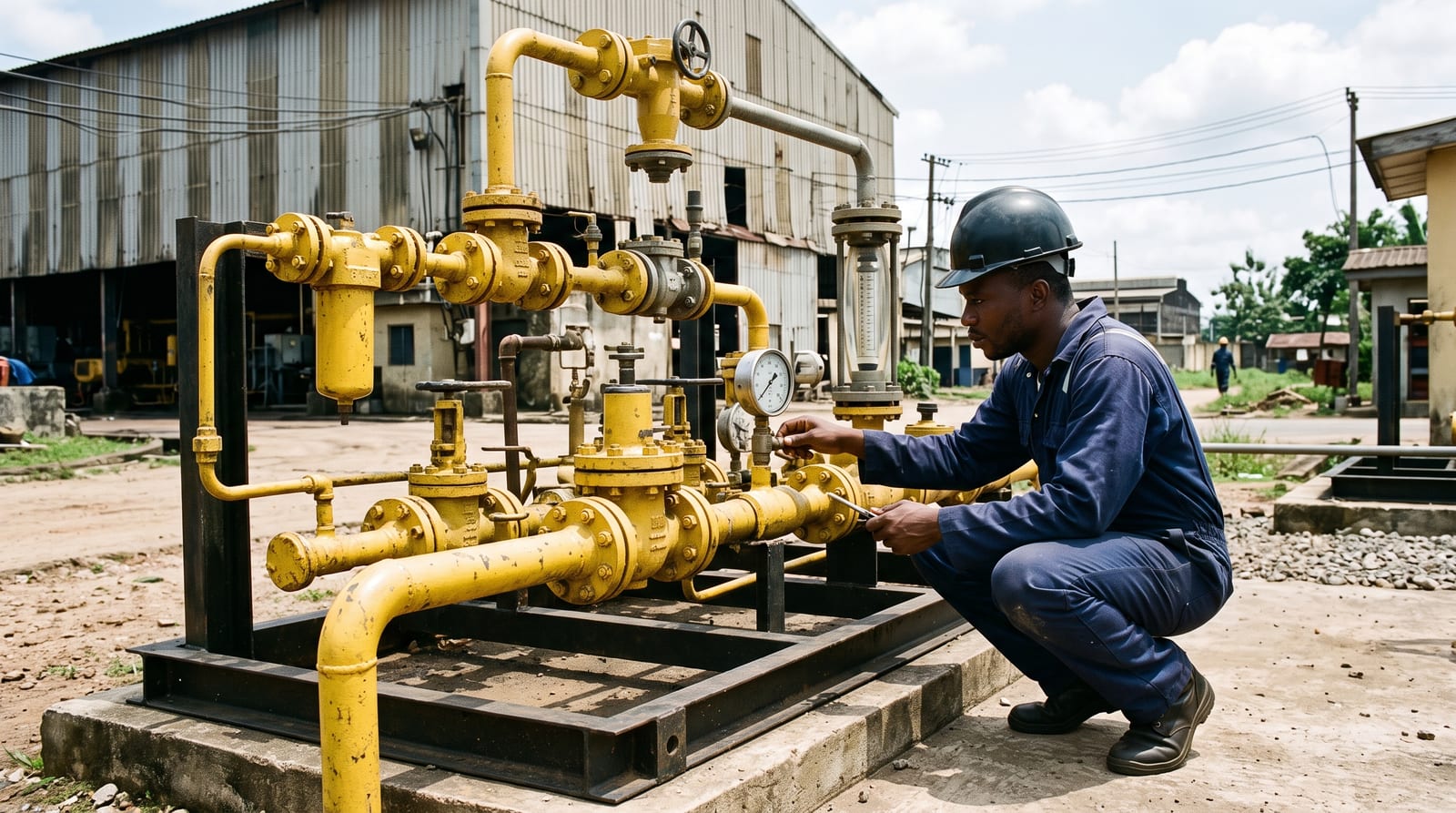 Gas pressure reduction and metering skid outside a factory
Worked example: a factory with 1MW average load
This example shows the method. All inputs are labelled assumptions; replace them with your figures.
Inputs
- Average electrical load: 1,000kW (assumption)
- Generator running hours: 20 hours per day, 26 days per month (assumption; this reflects a site where grid supply covers little of the day)
- Monthly energy: 1,000 × 20 × 26 = 520,000 kWh
- Diesel: 0.30 L/kWh at ₦2,100/L (assumption and September 2026 price)
- Gas: 0.24 m³/kWh (calculated above), tested at ₦600 per m³ (test value, not a quote)
Fuel cost per month
- Diesel: 520,000 × 0.30 = 156,000 litres × ₦2,100 = ₦327.6 million
- Gas at ₦600/m³: 520,000 × 0.24 = 124,800 m³ × ₦600 = ₦74.9 million
- Monthly fuel saving: about ₦252.7 million
What the saving has to pay for
The monthly fuel saving has to repay the extra capital (new gas engines or conversion, gas train, plant room changes), any increase in maintenance cost, the cost of a supply buffer or diesel backup, and any gas connection or pipeline charges. Divide the extra capital by the net monthly saving to get a simple payback in months, then test it at higher gas prices and lower running hours.
How running hours change the decision
At 20 hours per day the saving is large and payback is quick. A site with reliable Band A supply that only runs generators four hours a day produces one-fifth of the energy, one-fifth of the saving, and a much longer payback. Hours run decide the business case as much as prices do. Log them before you decide.
Gotchas
Comparing datasheet consumption, not real consumption
Your real litres per kWh at your real load may be well above the datasheet. Measure it.
Ignoring low-load operation
Both engine types lose efficiency at low load. An oversized gas plant can disappoint just as much as an oversized diesel plant.
Signing gas supply without interruption remedies
A cheap contract that stops without notice sends you back to diesel at the worst moment.
Treating bi-fuel substitution claims as guaranteed
Substitution depends on engine and load. Make measured performance a condition of acceptance.
Forgetting the plant room
Gas needs detection, ventilation and safety shut-offs. Retrofitting these late is expensive.
Key takeaways
- At ₦2,100 per litre and 0.30 litres per kWh, diesel generation costs about ₦630 per kWh in fuel alone.
- A modern gas engine uses roughly 0.24 m³ of gas per kWh, giving a break-even gas price near ₦2,625 per m³ against diesel.
- Capital, maintenance, supply reliability and running hours decide the real answer, not fuel price alone.
- Bi-fuel conversion suits diesel fleets with life left, but only with measured substitution rates written into acceptance.
- Measure your real consumption per kWh and hours run before building any business case.
Frequently asked questions
Is gas always cheaper than diesel for generators in Nigeria? On fuel cost per kWh at current prices, gas is usually far cheaper where it is available. Capital, supply reliability and running hours decide the full answer.
How much diesel does a generator use per kWh? Typically 0.28–0.40 litres per kWh around 75 percent load, and more at low load. Your own meter and fuel records give the true figure.
Can I convert my diesel generator to run on CNG? Many diesel sets can take bi-fuel kits that replace part of the diesel with gas. Full gas operation needs a gas engine. Conversion requires a gas safety design.
What happens if gas supply fails? Design for it with storage, contracts with interruption remedies, and diesel or dual-fuel backup for critical loads.
Is solar a better option than gas? Solar suits daytime load and can cut fuel use sharply, but a factory running at night or around the clock still needs firm generation. Many sites combine gas and solar.
Related reading
- How to Build an Independent Power Project (IPP) in Nigeria
- NERC Net Billing Regulations 2026 Explained
- Power Factor Correction: How Nigerian Maximum Demand Customers Cut Bills
Want your own TCO model? Send Lobcom three months of fuel records and generator meter readings. We will build a plant-specific model and a gas, bi-fuel or hybrid option with firm engineering costs. Start the conversation.
Sources
- The Frontier: Diesel crosses ₦2,000/litre
- Independent: Manufacturers lament rising energy costs
- Metric Suite: Generator vs grid power cost calculator
- Titanium Power Solutions: Diesel vs petrol generators in Nigeria
- Green Calculus: DEFRA 2026 fuel calorific values
- Oladokun & Asemota: Unit cost of electricity in Nigeria (RePEc)
- Opaindex: Band A tariff
- State House: MDGIF CNG projects
- BusinessDay: End of diesel generator nears for manufacturers