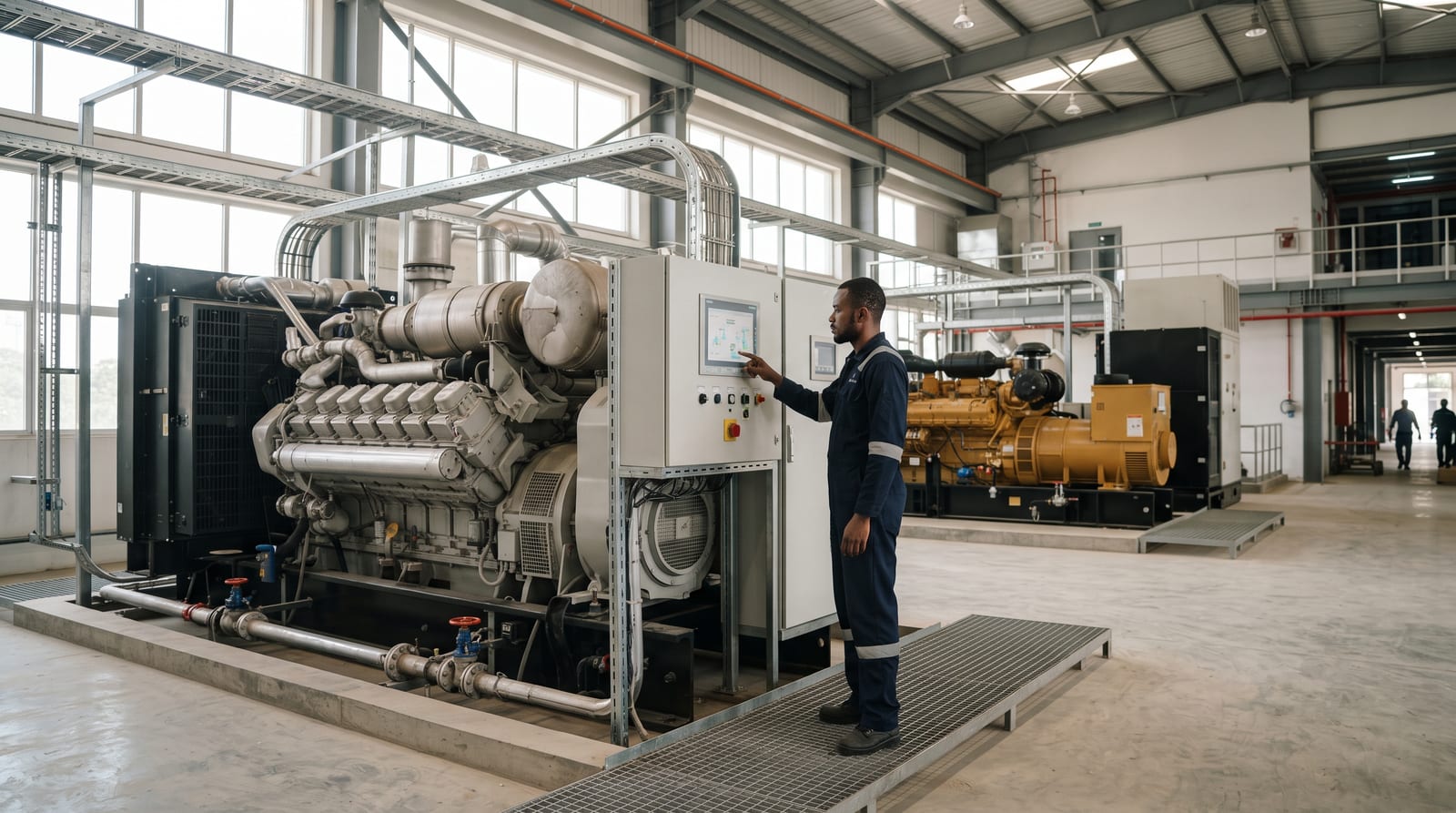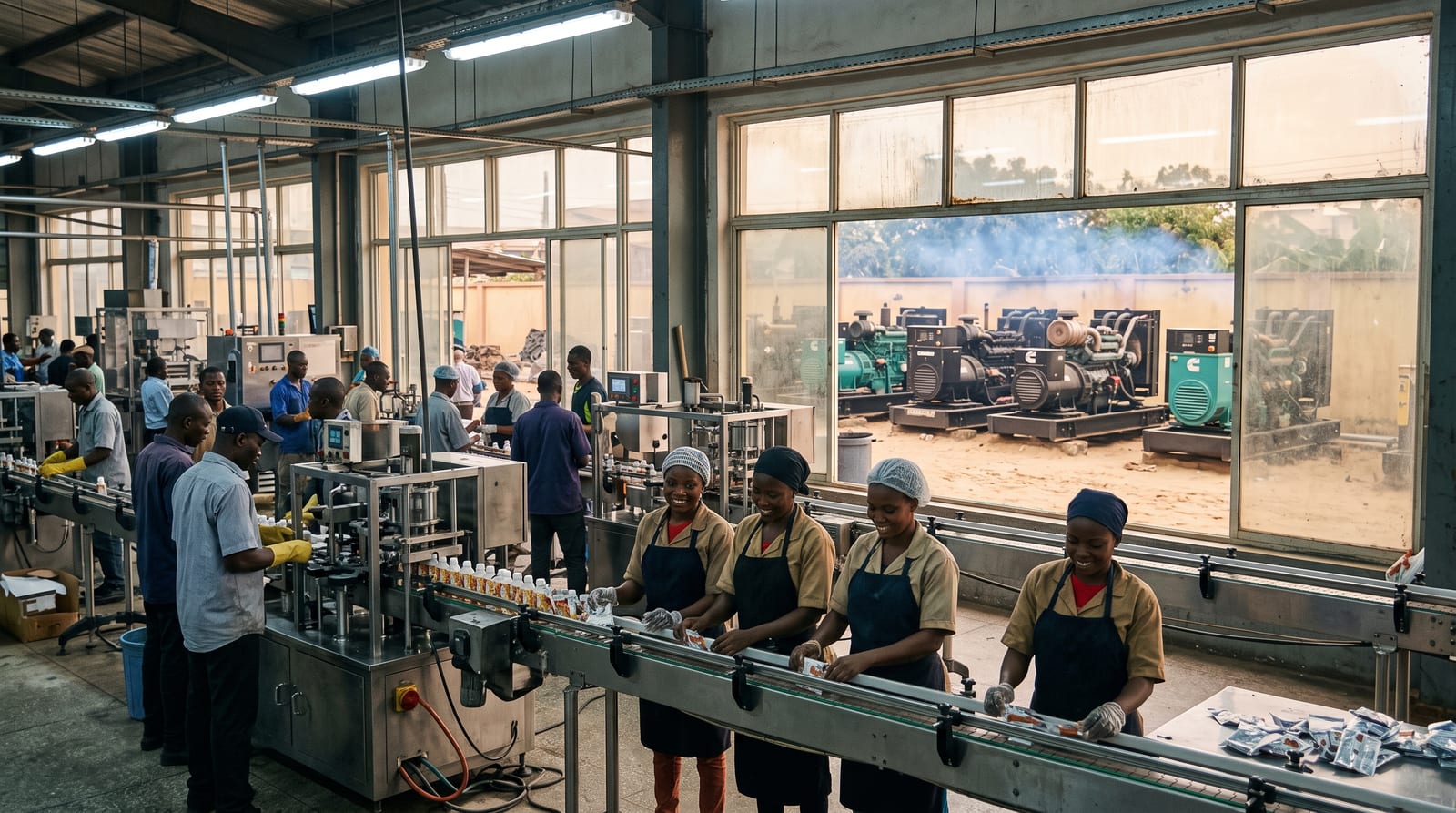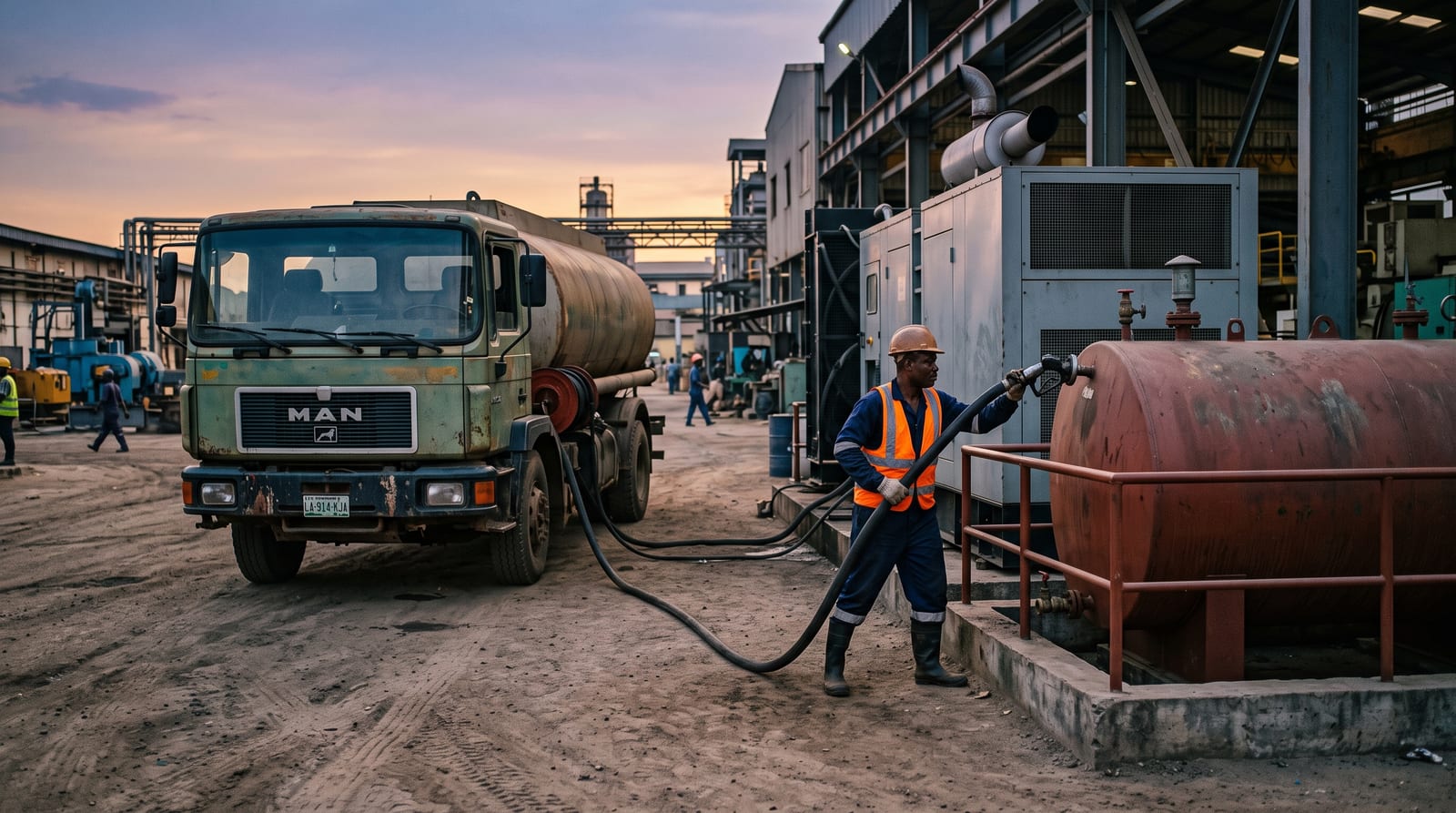
A factory running 1MW of load on diesel for 20 hours a day now burns about ₦327 million a month in fuel alone.
That number isn't a forecast. It is arithmetic: 520,000 kWh a month, 0.30 litres per kWh, ₦2,100 a litre. Every input is labelled below so you can swap in your own.
Here is the uncomfortable part. Somewhere on your calendar there is a month after which staying on diesel has cost you more than building your own gas-fired plant would have. For many Nigerian factories, that month has already passed.
This piece shows you how to find yours in about ten minutes, without a single vendor quote.
The price that changed the maths
In early September 2026, diesel jumped to about ₦2,100 a litre in Lagos and Ogun, up from ₦1,700–₦1,800 only days before (The Frontier, citing The Guardian).
The Lagos Chamber of Commerce puts the pre-crisis baseline at about ₦900. Diesel has more than doubled.
What that means per unit of electricity:
| Diesel price | Fuel cost per kWh (at 0.30 L/kWh) |
|---|---|
| ₦900 (pre-crisis baseline) | ₦270 |
| ₦1,500 | ₦450 |
| ₦2,100 (September 2026) | ₦630 |
For comparison, Band A grid supply costs ₦209.5 per kWh (Opaindex).
So every hour your factory runs on diesel instead of the grid costs about three times as much per unit. And MAN says the grid gave its members an average of just 13.1 hours a day in the second half of 2025 (Africa Business Insight).
The consequence nobody budgets for
Manufacturers spent ₦1.34 trillion generating their own electricity in 2025. MAN says spending in the first half of 2026 alone matched the whole of 2025 (The Frontier).
MAN's Director-General said power costs, which used to be about 40 percent of members' operating costs, now exceed 50 percent.
Businesses are responding in the only ways that do not need capital:
- Stopping night shifts.
- Switching generators off at 5pm sharp.
- Stretching delivery times. One manufacturer told Oriental News deliveries had gone from 7–10 days to three weeks because of diesel rationing (Oriental News).
Rationing is not a strategy. It is a slow way to lose customers while still paying for fuel.
The insight: stop asking "how much does a plant cost?"
Most factory owners start with the wrong question. They ask a vendor what a gas plant costs, get a big number, and shelve the idea.
Flip it. Ask instead:
"How much could I spend on my own plant and still be better off within 24 months?"
That number comes entirely from your own fuel bill. No quote needed. If a real quote later comes in below it, the project pays for itself inside your target period. If it comes in above, you know exactly how far above.
We call it your maximum justifiable capex.
The worksheet
Five inputs. Label each one as your figure or assumption.
1. Average load (kW). From your generator controllers or a load logger. Your figure.
2. Generator hours per month. From hour meters or your changeover log. Your figure.
3. Monthly energy (kWh) = load × hours.
4. Diesel cost per kWh = litres per kWh × diesel price.
- Litres per kWh: divide litres delivered by kWh on the generator meter. If you do not have meters, 0.30 is a reasonable planning figure for well-loaded industrial sets. Assumption unless measured.
- Diesel price: your latest invoice.
5. Gas cost per kWh = gas consumption per kWh × delivered gas price.
- Consumption: about 0.24 m³ per kWh for a modern gas engine. That comes from natural gas at roughly 11.1 kWh per m³ (DEFRA 2026 factors) and an assumed 38 percent electrical efficiency. Assumption; replace with the engine datasheet.
- Gas price: your supplier's delivered quote in ₦ per m³. Below we use ₦600 as a test value, not a market quote.
Then:
- Monthly saving = monthly kWh × (diesel cost per kWh − gas cost per kWh) − extra operating costs (operators, gas-specific maintenance, supply buffer).
- Maximum justifiable capex = monthly saving × your target payback months.
- Break-even month = actual capex quote ÷ monthly saving.
Three factories, three answers
All three use diesel at ₦2,100/L and 0.30 L/kWh, gas at a test price of ₦600/m³ and 0.24 m³/kWh. Operating-cost differences are left out so you can see the raw fuel effect; subtract yours.
Factory A: a mid-sized food processor
- Load: 250kW. Hours: 12 a day, 26 days. Assumptions.
- Energy: 78,000 kWh a month.
- Diesel: 78,000 × 0.30 × ₦2,100 = ₦49.1 million
- Gas: 78,000 × 0.24 × ₦600 = ₦11.2 million
- Fuel saving: ₦37.9 million a month
- Maximum justifiable capex for 24-month payback: about ₦910 million
Factory B: a 1MW plant with weak grid supply
- Load: 1,000kW. Hours: 20 a day, 26 days. Assumptions.
- Energy: 520,000 kWh a month.
- Diesel: ₦327.6 million
- Gas: 520,000 × 0.24 × ₦600 = ₦74.9 million
- Fuel saving: ₦252.7 million a month
- Maximum justifiable capex for 24-month payback: about ₦6.1 billion
Factory C: a 3MW continuous-process site
- Load: 3,000kW. Hours: 24 a day, 30 days. Assumptions.
- Energy: 2,160,000 kWh a month.
- Diesel: 2,160,000 × 0.30 × ₦2,100 = ₦1.36 billion
- Gas: 2,160,000 × 0.24 × ₦600 = ₦311 million
- Fuel saving: ₦1.05 billion a month
- Maximum justifiable capex for 24-month payback: about ₦25.2 billion
Read those last lines again. They are not what a plant costs. They are how much a plant could cost and still pay for itself in two years at these prices. The gap between that ceiling and a real engineering quote is the size of the opportunity you are leaving on the table.
Finding your break-even month
Once you have a real quote, the calculation is one line:
Break-even month = extra capital ÷ net monthly saving
Suppose Factory A receives a quote that implies ₦455 million of extra capital (half its 24-month ceiling; an illustrative figure, not a price). At ₦37.9 million saved a month, break-even arrives in month 12.
From month 13, every month on diesel is money the plant would have returned.
Now turn it around. Every month you delay the decision costs you one month of saving. For Factory B, that is about ₦253 million per month of indecision.
What can move your break-even month
The arithmetic above is deliberately simple. Four things change it, and you should test each one.
1. Gas price and supply reliability
Test your saving at twice your quoted gas price. If the project still pays back inside your target, gas price risk is manageable. Then look at supply: a pipeline connection, a CNG virtual pipeline, and how long you can run if a delivery is late. A cheap contract that stops without warning sends you back to diesel at the worst moment. Build in a storage buffer or keep diesel backup for critical load.
2. Hours run
The single biggest variable. A factory with reliable Band A supply that runs generators four hours a day saves one-fifth of what a 20-hour factory saves. Before you trust any business case, pull a month of changeover logs and count the real hours.
3. Your real litres per kWh
If your sets are oversized and lightly loaded, your real figure could be well above 0.30, which makes diesel even worse and the saving even bigger. Measure it.
4. The diesel price itself
At the pre-crisis ₦900, Factory B's diesel fuel bill would have been about ₦140 million a month instead of ₦328 million. Prices can fall. Test your case at ₦1,500 and ₦1,200. If it still works, diesel price risk is on your side.
"But we can't raise that capital"
You may not have to. Three structures are common:
- Build-own-operate: a developer builds and runs the plant on your site and sells you power per kWh. You pay nothing upfront and swap a diesel bill for a lower tariff.
- Cluster plants: several factories in one industrial area share a plant. MAN members have discussed IPPs for clusters and zones (Oriental News).
- Phased build: start with engines for your base load and add units as savings come in.
Pension funds and infrastructure guarantors are also circling the sector. At the Delta State summit, InfraCredit and others pledged investment in power infrastructure, and speakers pointed to Nigeria's pension assets of over ₦31 trillion as a source of long-term funding (ThisDay).
 Factory manager reviewing fuel receipts with a generator visible outside
What the regulator needs from you
A plant above 1MW for your own use needs a NERC captive generation permit; selling surplus has further rules (NERC captive regulation). If your state has taken over electricity regulation, intrastate projects answer to the state regulator. Our guide Captive, Embedded or Mini-Grid? explains which route fits.
The Power Minister has told manufacturers directly that the era of the diesel generator as their main power source is ending, and that "the competitive advantage belongs to those who act first" (BusinessDay).
How to put this in front of your board
The worksheet produces a handful of numbers. Presented well, they turn "we should look at gas" into a decision. A one-page board paper needs five parts.
1. The problem in naira
"In the last three months we spent ₦X on diesel, generating Y kWh at ₦Z per kWh. Band A grid power costs ₦209.5 per kWh." One sentence, three measured numbers.
2. The maximum justifiable capex
"At a test gas price of ₦P per m³, an efficient gas plant would save about ₦S per month. Over 24 months that is ₦C: the most we could spend and still recover it in two years." Show the sensitivity at twice the gas price and at a lower diesel price.
3. The risks, stated plainly
Gas supply reliability, the gas contract terms, the regulatory route (captive permit, mini-grid, or state licence), construction time, and operating capability. For each, one line on how it would be managed.
4. The options
Own-build, build-own-operate with a developer, a shared cluster plant, or bi-fuel conversion of existing sets. One line each on capital needed, control, and speed.
5. The ask
Usually not "approve a power plant", but "approve a load study, a gas supply enquiry and a feasibility study, so that we can return with a firm number in a defined number of weeks." That is a small, low-risk decision that stops the monthly loss from being ignored.
Why this works
Boards reject large, vague capital requests. They approve small, specific steps with a clear value attached. Your fuel bill already provides the value. The board paper just makes it visible.
Do this today
- Pull your last three months of diesel invoices.
- Read your generator hour meters and, if you have them, kWh meters.
- Work out your real litres per kWh.
- Run the worksheet above with your numbers.
- Write your maximum justifiable capex on one line, and your monthly saving on the next.
Take those two numbers to your next board meeting. They start a very different conversation from "a gas plant is expensive."
What we've learned building plants
Lobcom has built generation plants from 3MW to 8MW, including an 8MW plant at Sagamu and a 6MW plant at Apapa for Uraga Power (Honeywell Group), the 5MW Ekiti IPP, and a 4MW university IPP with its own underground network. Three lessons repeat on every project:
- Size from logged load, not nameplates. Oversized plants waste the saving you built them for.
- Settle fuel before engines. The gas contract decides the economics.
- Meter everything. A plant that cannot prove its cost per kWh cannot prove it paid back.
Gotchas
Using a vendor's litres-per-kWh figure
Your real figure at your real load is what your bill reflects. Measure it.
Ignoring hours run
The saving scales directly with generator hours. Count them from logs, not memory.
Treating the gas test price as a quote
Replace ₦600 with your supplier's delivered price before deciding anything.
Forgetting operating costs
Operators, gas-specific maintenance and a supply buffer come off the saving.
Key takeaways
- At ₦2,100 a litre and 0.30 litres per kWh, diesel power costs about ₦630 per kWh in fuel alone, three times Band A grid power.
- The right first question is not what a plant costs, but how much you could spend and still pay back within your target period.
- Maximum justifiable capex = monthly saving × target payback months, and it comes entirely from your own fuel bill.
- Every month of delay costs one month of saving; for a 1MW, 20-hour factory that is about ₦253 million on these assumptions.
- Hours run, real litres per kWh, gas price and supply reliability decide the answer, so test all four.
FAQs
Is ₦600 per m³ a real gas price? No. It is a test value to show the method. Use your supplier's delivered price.
What if my factory only runs generators a few hours a day? Your saving is proportionally smaller. Solar with net billing, better load scheduling or claiming Band A credits may be better first steps.
Can I convert my existing diesel sets instead of buying new engines? Often, with bi-fuel kits that replace part of the diesel with gas. See our guide Gas vs Diesel Generators: A Total Cost of Ownership Model.
How long does a gas plant take to build? It depends on size, gas supply readiness, equipment lead times and licensing. The load study and fuel contract usually take longer than installation.
Send us your numbers. Share three months of diesel invoices and generator hours with Lobcom's power team, and we will return your break-even month and a plant sized to your real load. Start here.
Sources
- The Frontier: Diesel crosses ₦2,000/litre
- Opaindex: Band A tariff
- Africa Business Insight: Manufacturers spend US$930m on alternative power
- Oriental News: Manufacturers mull independent power
- Green Calculus: DEFRA 2026 fuel calorific values
- ThisDay: Delta unveils roadmap to unlock 3,000MW
- NERC Regulation for Captive Power Generation
- BusinessDay: End of diesel generator nears for manufacturers