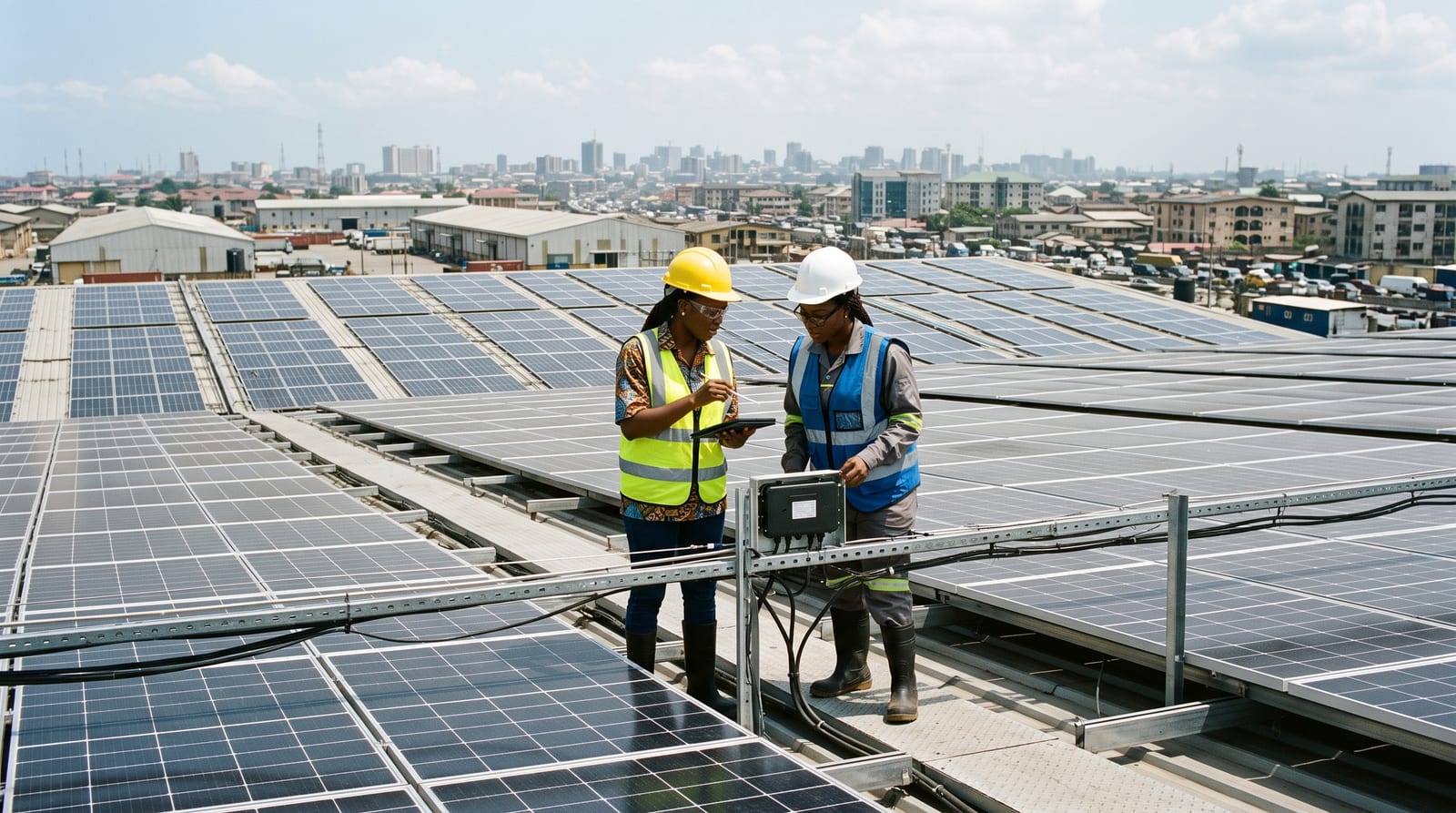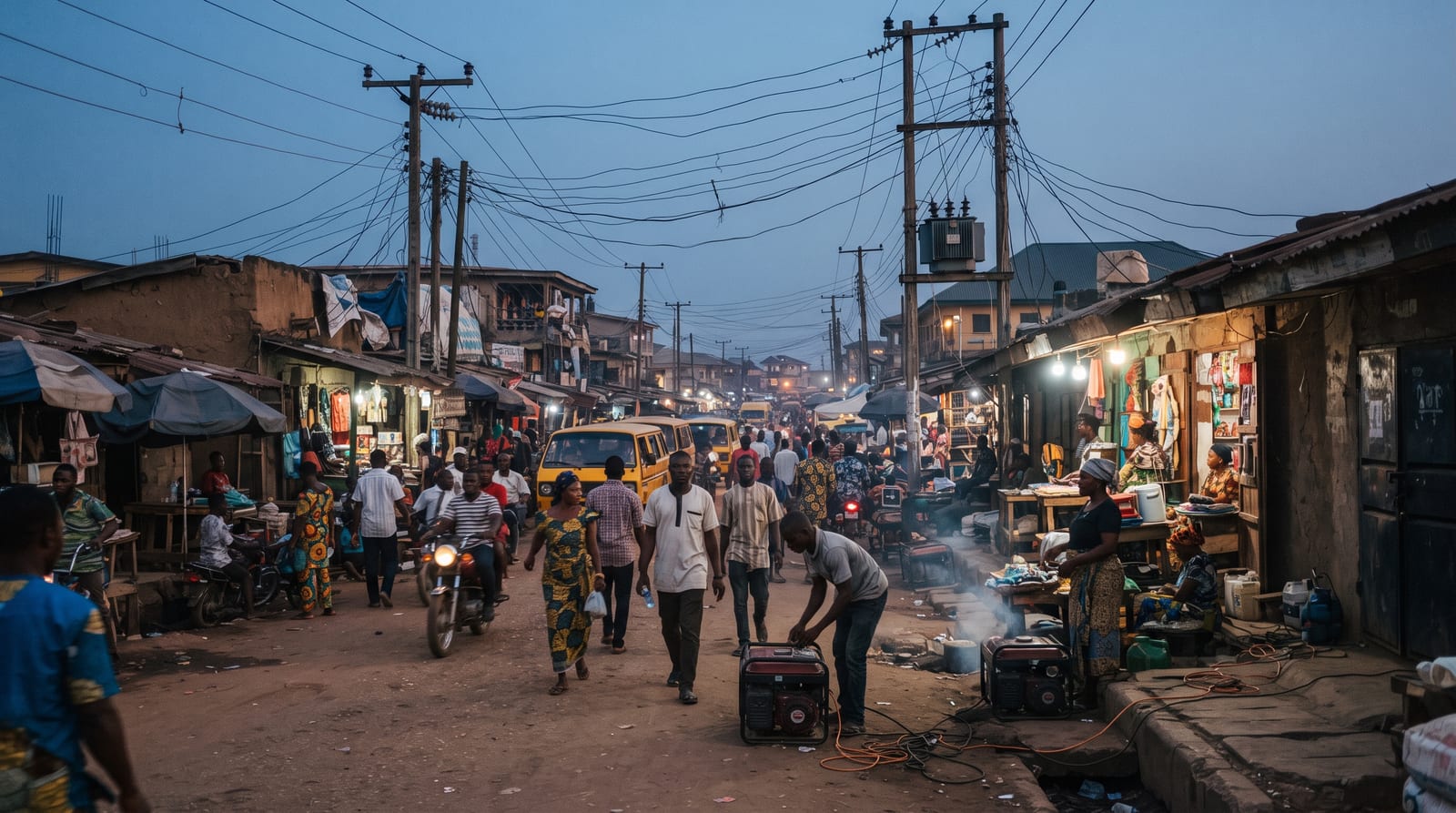
If your facility generates its own electricity in Nigeria, the regulatory route depends on four questions: how much capacity you install, whether you consume all the power yourself, whether you connect to a DisCo network, and which state you are in. Get the answers right and the paperwork is manageable. Get them wrong and you can find yourself running an unlicensed plant, unable to sell surplus power, or re-applying to a state regulator after NERC has already approved you. This guide sets out the four main routes (captive generation permit, embedded generation licence, mini-grid permit, and the state route under the Electricity Act 2023), what each one allows, what documents each needs, and how to choose between them.
This is an engineering guide to the regulatory landscape, not legal advice. Confirm your position with the regulator or your counsel before committing capital.
What's in this guide
- What counts as "generating your own power" in regulatory terms?
- When do you need a captive generation permit?
- When do you need an embedded generation licence?
- When is a mini-grid permit the right route?
- Does your state regulator replace NERC?
- How do you choose the right route for your facility?
- What technical documents will any route require?
The numbers at a glance
| Route | Capacity trigger | Can you sell power? | Connection | Source |
|---|---|---|---|---|
| Captive generation permit | Above 1MW, for own consumption | Surplus up to 1MW only with NERC's prior written consent; above 1MW needs a generation licence | Behind the meter | NERC Captive Power Generation Regulation |
| Embedded generation licence | Units >1MW; 1–6MW at 11kV, 6–20MW at 33kV | Yes, through the DisCo network under PPA and connection agreements | DisCo distribution network | NERC Embedded Generation Regulations 2012 |
| Isolated mini-grid permit | Up to 5MW per site | Yes, to customers on the mini-grid | Not connected to DisCo | NERC Mini-Grid Regulations 2026 |
| Interconnected mini-grid permit | Up to 10MW per site | Yes, under a tripartite agreement with the DisCo | Connected to DisCo | NERC Mini-Grid Regulations 2026 |
| Net billing registration | 50kWp–1.5MWp renewable | Bill credits for exported energy | DisCo network | NERC Net Billing Regulations 2026 |
| NERC licence processing | Up to 6 months | — | — | NERC licensing page |
| NERC permits issued Q1 2026 | 7 captive permits (40.82MW), 6 mini-grid permits, 1 embedded licence, 1 IEDN licence | — | — | NERC 2026 Q1 Report |
What counts as "generating your own power" in regulatory terms?
Generating your own power means operating generation equipment whose output is not bought from a licensed distribution company. The regulator cares about three facts: capacity, who consumes the output, and whether the equipment connects to a public network.
Why the distinctions matter
Each route carries different rights. A captive permit lets you generate for yourself; it does not let you run a power business. An embedded licence lets you sell through a DisCo network, but brings commercial agreements and grid compliance with it. A mini-grid permit lets you supply a defined community of customers, with tariff and customer-service obligations. Choosing the wrong route can block the thing you actually want to do, such as selling spare capacity to the factory next door.
How active is licensing right now?
Busy, and growing. In the first quarter of 2026 alone NERC issued 48 licences, permits and certifications, including seven captive generation permits totalling 40.82MW, six mini-grid permits, one embedded generation licence and one Independent Electricity Distribution Network (IEDN) licence (NERC 2026 Q1 Report). Industrial self-generation is no longer unusual. It is the mainstream response to a grid whose plants averaged 4,457.96MW of available capacity in the same quarter.
When do you need a captive generation permit?
You need a captive generation permit when you generate more than 1MW for your own consumption and do not sell it to a third party. NERC's Regulation for Captive Power Generation defines captive power generation as "generation of electricity exceeding 1 MW for the purpose of consumption by the generator".
What does the captive permit allow?
It allows a factory, campus, hospital or commercial complex to build and run a plant above 1MW for its own load. It does not create a right to sell. A permit holder must apply for and receive NERC's prior written consent before supplying surplus power not exceeding 1MW to an off-taker. To supply more than 1MW of surplus, the holder must obtain a generation licence.
What are the practical conditions?
- The permit is unit- and location-specific. Replacing engines with different units, or moving the plant, requires an amendment.
- The permit has a validity period (five years in the regulation's fee schedule) and must be renewed.
- Fees scale with capacity bands. The regulation's schedule shows application and permit fees by band; confirm the current schedule with NERC, because published figures date from the original regulation.
Who typically uses this route?
Manufacturers with steady process load and no intention of selling power. NERC has identified companies including Dangote Group, Flour Mills of Nigeria, Nigerian Breweries, Lafarge Africa and Nestlé Nigeria among those that moved towards self-generation (Africa Business Insight). For a mid-sized plant, the captive route is the lightest path to legal generation above 1MW.
What about plants at or below 1MW?
The captive regime applies above 1MW. A plant at or below that size, used only on your own premises, falls outside the captive permit requirement, although equipment standards, NEMSA safety requirements, environmental rules and local planning rules still apply. If you later want to export or supply others, the analysis changes.
When do you need an embedded generation licence?
You need an embedded generation licence when your plant connects to a DisCo's distribution network and sells electricity through it. The Embedded Generation Regulations 2012 govern this route.
How is embedded generation classified?
By size and connection voltage:
- Small units: nameplate above 1MW and not more than 6MW, connecting at 11kV.
- Large units: above 6MW and not more than 20MW, connecting at 33kV.
- Above 20MW: 33kV for every 20MW evacuated.
Embedded units above 5MW must comply with the applicable provisions of the Grid Code, and units of 20MW and above are centrally despatched by the system operator. The maximum embedded capacity on a DisCo system is capped as a percentage of that system's peak load, set by NERC.
What documents does NERC ask for?
NERC's generation licence page lists, for embedded applicants, draft agreements covering:
- Power purchase
- Connection
- Use of distribution system
- Ancillary services
- Fuel supply
It also requires Environmental Impact Assessment approval for plants of 10MW and above (or an effluent management policy below 10MW), a registered title deed and corporate documents. NERC's stated processing timeline is up to six months from a complete application.
When does this route make sense?
When your business case depends on selling power to the DisCo or to customers it serves, for example an industrial cluster plant selling to its members through the local network, or a developer building a plant to supply a DisCo feeder. It brings the most commercial complexity of the four routes, because every counterparty agreement must be in place.
When is a mini-grid permit the right route?
A mini-grid permit is the right route when you want to generate and distribute power to a defined set of customers, either independently of the DisCo (isolated) or in coordination with it (interconnected). NERC's Mini-Grid Regulations 2026 raised the ceilings significantly compared with earlier rules.
Isolated mini-grids: up to 5MW per site
An isolated mini-grid supplies electricity independently of a DisCo network, with installed capacity up to 5MW per site. For projects above 1MW, the regulations call for a simplified technical package: the single-line diagram, protection philosophy, basic equipment ratings, site layout and proportionate technical information. Smaller isolated systems follow a lighter registration path.
Interconnected mini-grids: up to 10MW per site
An interconnected mini-grid connects to and operates in coordination with a DisCo network, with installed capacity up to 10MW per site. The developer, the community or customers, and the DisCo sign a tripartite agreement. For interconnected mini-grids above 1MW, the developer must submit a System Impact Study, and additional metering, protection and communication requirements apply. Interconnected mini-grids of at least 1MW may apply for export capability at the point of common coupling.
Why campuses and estates should look closely at this route
A university, hospital or gated estate typically has one landlord, a defined boundary and many internal consumers. That is a mini-grid in all but name. The 2026 ceilings (5MW isolated, 10MW interconnected) now cover most campus and estate loads. Our 4MW university IPP with its underground network and metering, and our 3MW plant feeding an 8km network with ten substations, sit comfortably within these limits.
Does your state regulator replace NERC?
In states that have completed the transfer of regulatory oversight, the State Electricity Regulatory Commission (SERC) regulates generation, distribution and supply that begin and end within the state. NERC keeps interstate matters, the national grid interface and technical standards.
Which states have transferred oversight?
As of July 2026, sixteen states had completed the statutory transfer (BusinessDay). An April 2026 NERC list named fifteen at that date: Enugu, Ekiti, Ondo, Imo, Oyo, Edo, Kogi, Lagos, Ogun, Niger, Plateau, Abia, Nasarawa, Anambra and Bayelsa (Voice of Naija). Others are moving: Delta has announced its regulatory commission and rural electrification agency for 2026 (Summit Nigeria), and Ondo amended its power law to give its SERC authority over licences, mini-grids and third-party investment (Independent).
How do you tell which regulator applies?
Use the "follow the electrons" test:
- If power crosses a state or national border, NERC is involved.
- If the project is transmission-connected or sits on the national grid interface, NERC rules at that interface.
- If generation and supply are wholly within a transferred state, the SERC is the licensing authority.
- Whatever the regulator, meters, transformers, conductors and safety follow federal standards enforced by NEMSA.
- If the state has not completed its transfer, NERC remains the regulator, whatever the state's announcements say.
What is the risk?
Duplication and change. Some generators holding NERC licences have received letters from SERCs asking them to apply for state licences. The Senate's Electricity Act (Amendment) Bill 2026 has also been opposed by 16 state regulators, who identified 17 contentious provisions (Punch). Build regulatory review into the project plan at feasibility, financial close and commissioning.
How do you choose the right route for your facility?
Answer four questions in order, and the route mostly chooses itself.
Question 1: Will you consume everything you generate?
- Yes, and the plant is above 1MW: captive generation permit.
- Yes, and the plant is 1MW or less: no captive permit, but standards and safety apply.
- No, you want to sell surplus or supply others: go to Question 2.
Question 2: Who will you supply?
- Other consumers within a defined site you control (campus, estate, cluster): mini-grid permit, isolated or interconnected.
- The DisCo, or customers across its network: embedded generation licence.
Question 3: Will you connect to the DisCo?
- No: isolated mini-grid (up to 5MW per site) or captive.
- Yes: interconnected mini-grid (up to 10MW per site) or embedded generation; for renewable systems of 50kWp–1.5MWp that mainly offset your own bill, consider net billing (see our guide NERC Net Billing Regulations 2026 Explained).
Question 4: Which state are you in?
If your state has completed its transfer and the project is intrastate, approach the SERC. Otherwise approach NERC.
A worked example
A private university in Ogun State wants a 4MW gas plant supplying hostels, lecture halls, a hospital and staff housing on its own campus, with a DisCo connection kept as backup. It will not sell outside the campus.
- It supplies multiple internal consumers inside a defined site, so it looks like a mini-grid rather than pure captive.
- It keeps a DisCo connection, so the interconnected route and a tripartite agreement come into play, with a System Impact Study because it is above 1MW.
- Ogun completed its transfer, so the intrastate licensing authority is the state regulator, with NEMSA standards still applying.
The same university with no DisCo connection and 4MW would sit under the isolated mini-grid ceiling of 5MW.
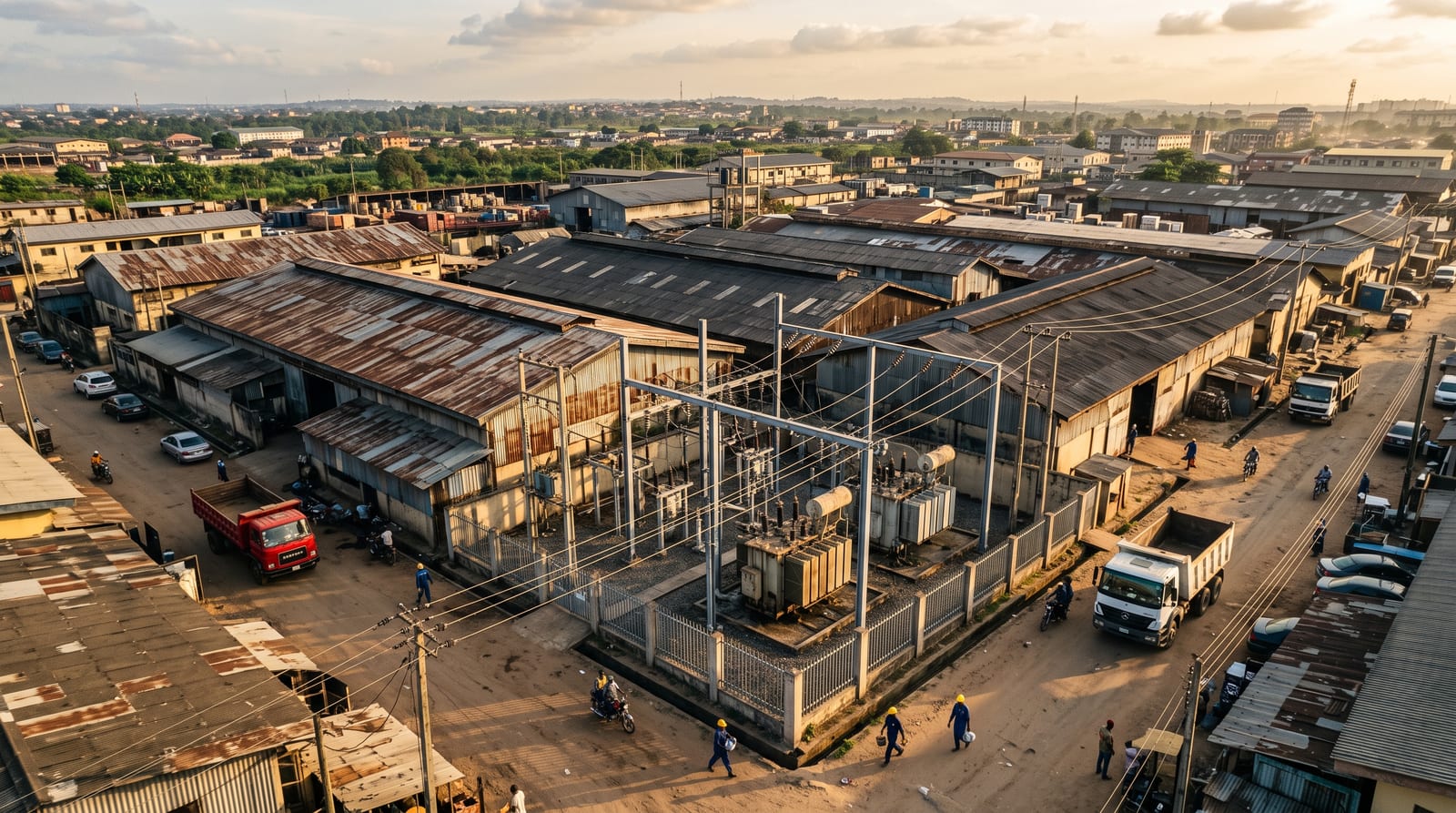 Aerial view of an industrial estate with a substation and power lines
What technical documents will any route require?
Every route asks for proof that the plant is safe, protected and properly designed. Prepare these early, because they drive both approval time and construction quality.
The core technical package
- Single-line diagram of generation, switchgear, transformers, feeders, protection and metering.
- Protection philosophy and relay coordination settings.
- Equipment ratings and datasheets for engines, alternators, transformers and switchgear.
- Earthing system design, certified by a qualified engineer.
- Site layout showing the plant, fuel or gas train, substations and cable routes.
- System Impact Study for interconnected mini-grids above 1MW and for most embedded projects.
- Metering arrangement complying with the Metering Code, with NEMSA-certified meters.
Commercial and corporate documents
- Evidence of land title or legal possession.
- Corporate registration documents.
- Fuel supply agreement (draft or signed).
- For sales routes: power purchase, connection and use-of-system agreements, and a tariff proposal.
- Environmental documentation: EIA for 10MW and above; an effluent and discharge policy for smaller plants.
Why engineering and licensing should be run together
Regulators ask engineering questions. If the SLD in your application does not match the plant you build, the NEMSA inspection and commissioning stage will expose it. Running design and licensing as one workstream means the drawings approved are the drawings built. That is why Lobcom prepares regulatory technical packages alongside design and construction rather than handing them to a separate adviser.
Gotchas
A captive permit is not a trading licence
Selling surplus above 1MW needs a generation licence, and even smaller surplus sales need NERC's prior written consent.
Changing engines can void your permit
Captive permits are unit- and location-specific. Plan an amendment before swapping or relocating units.
Two regulators, one plant
In transferred states, intrastate projects answer to the SERC. Projects licensed by NERC before the transfer have received state licensing requests.
The System Impact Study is often the critical path
Interconnected projects above 1MW cannot proceed without it, and it depends on DisCo network data you do not control.
Net billing is not a mini-grid
Net billing covers renewable systems of 50kWp–1.5MWp offsetting your own bill. It does not let you supply other customers.
Key takeaways
- Generating more than 1MW for your own use requires a NERC captive generation permit, and it does not give you the right to sell power.
- Selling through a DisCo network requires an embedded generation licence with full commercial agreements and a processing time of up to six months.
- The 2026 mini-grid regulations allow isolated systems up to 5MW and interconnected systems up to 10MW per site, which covers most campuses and estates.
- In the 16 states with transferred oversight, intrastate projects are licensed by the state regulator while equipment standards remain federal.
- The technical package (SLD, protection, earthing, metering) determines approval speed and should be produced by the team that will build the plant.
Frequently asked questions
Do I need a permit for a 500kVA generator at my office? Not a captive generation permit, which applies above 1MW. You still need a safe, standards-compliant installation, and your state or local authority may have environmental and planning requirements.
Can I sell power to the factory next to mine? Under a captive permit you need NERC's prior written consent to sell surplus up to 1MW, and a generation licence above that. A mini-grid or embedded route may fit better if selling is part of the plan. In transferred states, check the state framework.
How long do approvals take? NERC states up to six months for generation licences from a complete application. Mini-grid permits and captive permits can be quicker when the technical package is complete. Interconnected projects also depend on the DisCo's System Impact Study.
What is an IEDN? An Independent Electricity Distribution Network is a distribution system not directly connected to the transmission system, defined in NERC's embedded generation regulations. NERC issued one IEDN licence in Q1 2026.
Does solar change the route? Solar and battery systems can sit under any of these routes. For grid-connected renewable systems of 50kWp–1.5MWp that offset your own consumption, the Net Billing Regulations 2026 add a bill-credit option.
Related reading
- How to Build an Independent Power Project (IPP) in Nigeria
- NERC Net Billing Regulations 2026 Explained
- Smart Metering for Estates and Universities
Not sure which route fits? Send Lobcom your load profile and site plan. We will map the route, prepare the SLD, protection and earthing package, and build the plant the regulator approved. Talk to our engineers.
Sources
- NERC Regulation for Captive Power Generation
- NERC Embedded Generation Regulations 2012
- NERC Generation Licence page
- NERC Licensing and Authorisation page
- NERC Mini-Grid Regulations 2026
- NERC 2026 Q1 Report
- Africa Business Insight: Manufacturers spend US$930m on alternative power
- BusinessDay: NERC, SERCs and the regulatory turf war
- Voice of Naija: 21 states yet to take control of electricity markets
- Summit Nigeria: Delta plans independent electricity market
- Independent: Ondo amends power law
- Punch: States kick as Senate moves to amend Electricity Act