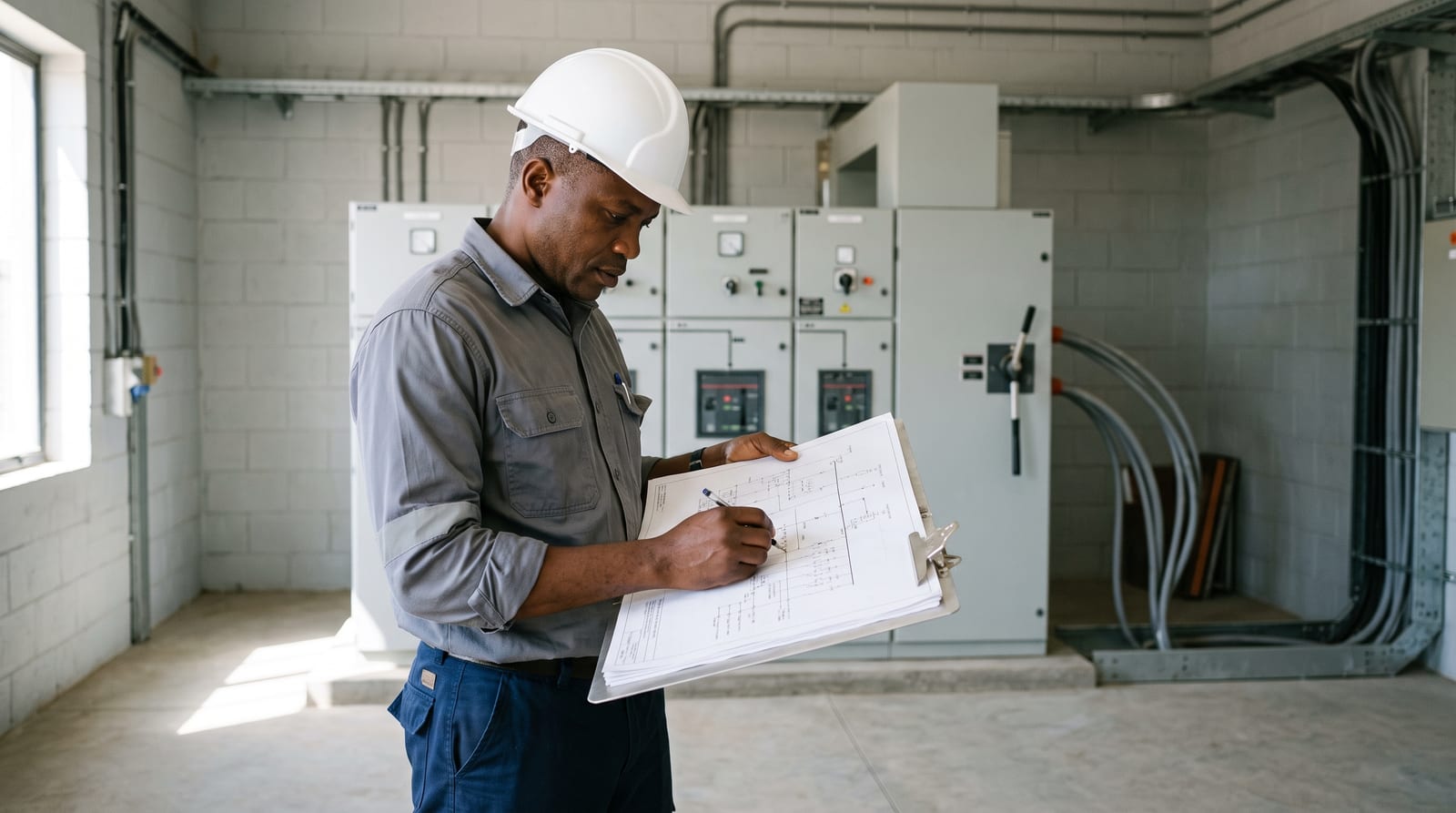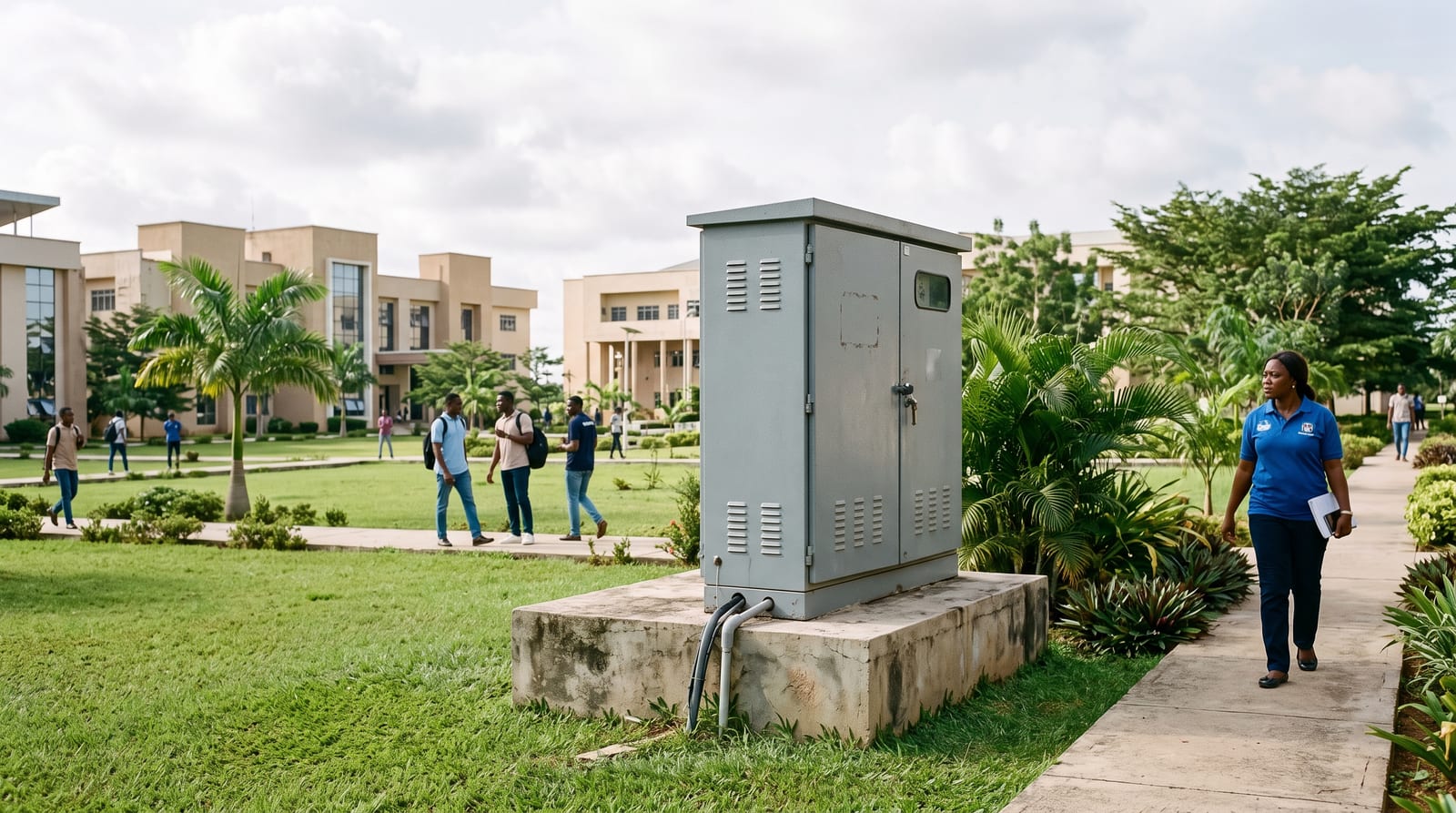
Smart metering on a campus or estate is the system of meters, communications and software that measures electricity at every point where it is generated, distributed and consumed, and turns those readings into bills, loss reports and alarms. For a university, hospital or gated estate running its own power plant or buying power in bulk, it is the difference between knowing where every kilowatt-hour went and guessing. Nigeria's national picture shows what guessing costs: 4.85 million active electricity customers were still unmetered in June 2026 (Vanguard), and estimated billing remains the leading source of disputes. This guide explains how to design metering for a private network, which meters to use where, how to connect them, how to set tariffs, and how to roll it out without a residents' revolt.
What's in this guide
- Why do estates and campuses still bill by estimate?
- What does a complete metering architecture look like?
- Which meter types belong where?
- How do smart meters communicate?
- How do you find and cut energy losses?
- How should you set tariffs and billing?
- How do you roll out metering without disputes?
The numbers at a glance
| Figure | Value | Source |
|---|---|---|
| National metering rate, June 2026 | 61.51% | NERC via ThisDay |
| Active customers, June 2026 | 12.59 million | NERC via Vanguard |
| Metered customers, June 2026 | 7.74 million | NERC via Vanguard |
| Unmetered active customers | ~4.85 million | NERC via Vanguard |
| Meters installed nationally, May–June 2026 | ~308,106 | NERC via Vanguard |
| Share of Q3 2025 installations under MAP | 77.12% | NERC via Tribune |
| Complaints at DisCo units, Q3 2025 | Over 168,000 | NERC via The Pinnacle |
Why do estates and campuses still bill by estimate?
Estates and campuses bill by estimate because their networks were built to deliver power, not to measure it. A developer installs a transformer, feeder pillars and service cables, connects each house or building, and then divides the bill by headcount, floor area or a flat service charge.
What estimated billing costs the operator
- Unrecovered energy. High consumers pay the same as low consumers, so the operator subsidises the heaviest users.
- Invisible losses. Without feeder and building meters, theft, faulty connections and cable losses disappear into the average.
- No demand control. Residents with no price signal run air conditioners and water heaters without restraint, pushing up peak demand and generator hours.
- Disputes. Every estimate is arguable. The national figures show how common those arguments are: over 168,000 complaints were recorded at DisCo customer units in the third quarter of 2025 alone, many linked to billing (The Pinnacle).
Why the national programmes do not solve it for you
Federal schemes, the Meter Asset Provider (MAP) framework and the Presidential Metering Initiative meter DisCo customers. They do not meter the internal network of a private campus or estate that buys power in bulk or generates its own. Behind your bulk meter, metering is your responsibility.
Why the problem gets bigger with your own plant
When a campus runs its own generation, every unaccounted kilowatt-hour costs fuel. At ₦2,100 per litre of diesel (The Frontier) and an assumed 0.3 litres per kWh, a kilowatt-hour lost on the network costs about ₦630 in fuel alone. Metering is how you find those losses.
What does a complete metering architecture look like?
A complete architecture meters energy at three levels, generation, distribution and consumption, so that the difference between levels reveals losses and every consumer is billed on measured use.
Level 1: Generation and supply points
Meter every source: each generator or the plant's main outgoing breaker, the DisCo bulk supply point, and any solar inverter output. These meters answer "how much did we produce or buy?"
Level 2: Feeders and substations
Meter each medium-voltage feeder leaving the plant and each distribution transformer or packaged substation. These meters answer "where did it go?" On a campus network with several substations, feeder-level metering usually finds the problem area within days.
Level 3: Buildings and end users
Meter every building, and within multi-occupancy buildings, every unit: each house on an estate, each hostel block, each lecture complex, the hospital, staff quarters, shops and commercial tenants. These meters answer "who used it?"
How the levels work together
Energy at Level 1 minus the sum of Level 2 gives losses on the medium-voltage network. Each Level 2 meter minus the sum of its Level 3 meters gives losses on that low-voltage area. A healthy network shows small, stable differences; a sudden jump shows a fault, bypass or theft in a specific area. Our university project combined an IPP, an underground distribution network and advanced metering for exactly this reason: reliable supply and lower operating costs depend on precise energy monitoring.
Which meter types belong where?
Choose meters by current level, accuracy need and billing method. The wrong meter in the wrong place produces numbers nobody trusts.
CT-operated meters for large loads
Above roughly 100A per phase, meters are connected through current transformers (CTs) rather than carrying the load current themselves. Use CT-operated meters at generators, feeders, substations and large buildings. Specify the CT ratio and accuracy class to match the load: an oversized CT reads poorly at low load.
Whole-current meters for homes and small units
Houses, flats, hostel rooms and small shops use whole-current single-phase or three-phase meters. Prepaid split meters, with the metering unit sealed in a secure enclosure and a customer interface unit inside the home, reduce tampering because the resident cannot reach the meter.
Prepaid or postpaid?
- Prepaid suits residential units and student accommodation. Payment comes before consumption, there is no debt to chase, and residents see their consumption directly.
- Postpaid (smart, remotely read) suits commercial tenants, departments and large users where monthly invoicing and demand charges apply.
- Many estates run both: prepaid for residents, postpaid for commercial users and common areas.
Accuracy and certification
All revenue meters should be NEMSA-certified and comply with the Metering Code. Technical standards for meters remain a federal matter even in states that regulate their own electricity markets (BusinessDay). Keep calibration certificates on file, because they are your evidence in any dispute.
How do smart meters communicate?
Smart meters send readings and receive commands through a communications layer, and the choice of layer decides how reliable your data is.
The components of an AMI system
Advanced metering infrastructure (AMI) typically includes:
- Meters with communication modules.
- Data concentrator units (DCUs) at substations or feeder pillars, collecting readings from nearby meters.
- A backhaul link from each DCU to the central system, usually cellular or fibre.
- A head-end system that polls meters and sends commands such as disconnect or tariff updates.
- Meter data management (MDM) software that stores readings, validates them, and feeds billing and loss reports.
- A vending system for prepaid tokens, often integrated with bank or mobile payments.
Which communication method should you choose?
- Cellular (GSM/LTE) per meter: simple where signal is strong, with a recurring SIM cost per meter.
- RF mesh: meters relay each other's data to a DCU, which suits dense estates and campuses.
- Power line carrier (PLC): data travels over the power cables themselves; performance depends on network noise.
- Wired (RS-485/Modbus): best for meters in the same plant room or substation, feeding a SCADA or monitoring panel.
Most campus systems mix them: wired metering in the plant and substations, and RF or cellular for buildings and homes.
What about generator and plant monitoring?
Link generation meters and engine controllers to the same data platform. When fuel or gas consumption, engine hours and energy output sit alongside feeder and customer data, you can calculate your true cost per kWh delivered, not just produced. Lobcom's service covers smart meter deployment for grid and generator applications, hardware selection and calibration, and data acquisition with remote performance monitoring.
How do you find and cut energy losses?
You find losses by comparing energy between metering levels and investigating any gap that is larger than the network's normal technical losses. You cut them by fixing the physical cause, not by raising tariffs.
Technical losses
Every cable and transformer loses some energy as heat. Losses rise with the square of current, so they are highest on overloaded feeders, long low-voltage runs and transformers operating far from their design load. Solutions include rebalancing phases, adding substations closer to load centres, upsizing undersized cables, and correcting power factor (see our guide Power Factor Correction).
Commercial losses
Commercial losses are energy consumed but not billed: bypassed meters, direct connections, faulty meters, wrong CT ratios, and units that were never metered. Smart meters help by reporting tamper events, cover openings, reverse current and sudden consumption drops.
A loss investigation routine
- Pull monthly energy by level.
- Rank low-voltage areas by the gap between the area meter and the sum of customer meters.
- Inspect the worst area: meter seals, service cable joints, feeder pillar connections.
- Check CT ratios and meter programming against records.
- Repeat monthly, and track the trend.
Why underground networks help
Underground cable is much harder to tap than overhead line. On campuses and high-value estates, burying the network reduces both theft and the vandalism that interrupts supply. It is one of the reasons our university IPP used 11km of underground distribution.
How should you set tariffs and billing?
Set tariffs so that measured consumption recovers the variable cost of energy, and a fixed charge recovers the cost of the network, metering and service. Then publish the method.
The two-part tariff
- Energy charge (₦/kWh): fuel or bulk purchase cost per kWh delivered, including a fair allowance for technical losses.
- Fixed or service charge (₦/month): network maintenance, metering system costs, billing and administration.
Residents accept a tariff they can understand. Publish the basis: fuel price, generation efficiency, loss allowance, and when you will review it.
Reference points your residents will use
Residents compare your tariff with the DisCo's. Band A grid supply, which promises at least 20 hours a day, costs ₦209.5/kWh (Opaindex). If your supply is from diesel or gas generation, explain openly why your cost per kWh differs, with the fuel price and efficiency figures behind it.
Regulatory position
Selling power to residents or tenants on a private network can bring you into the mini-grid or distribution licensing framework, depending on your structure and state. See our guide Captive, Embedded or Mini-Grid? before you set a commercial tariff.
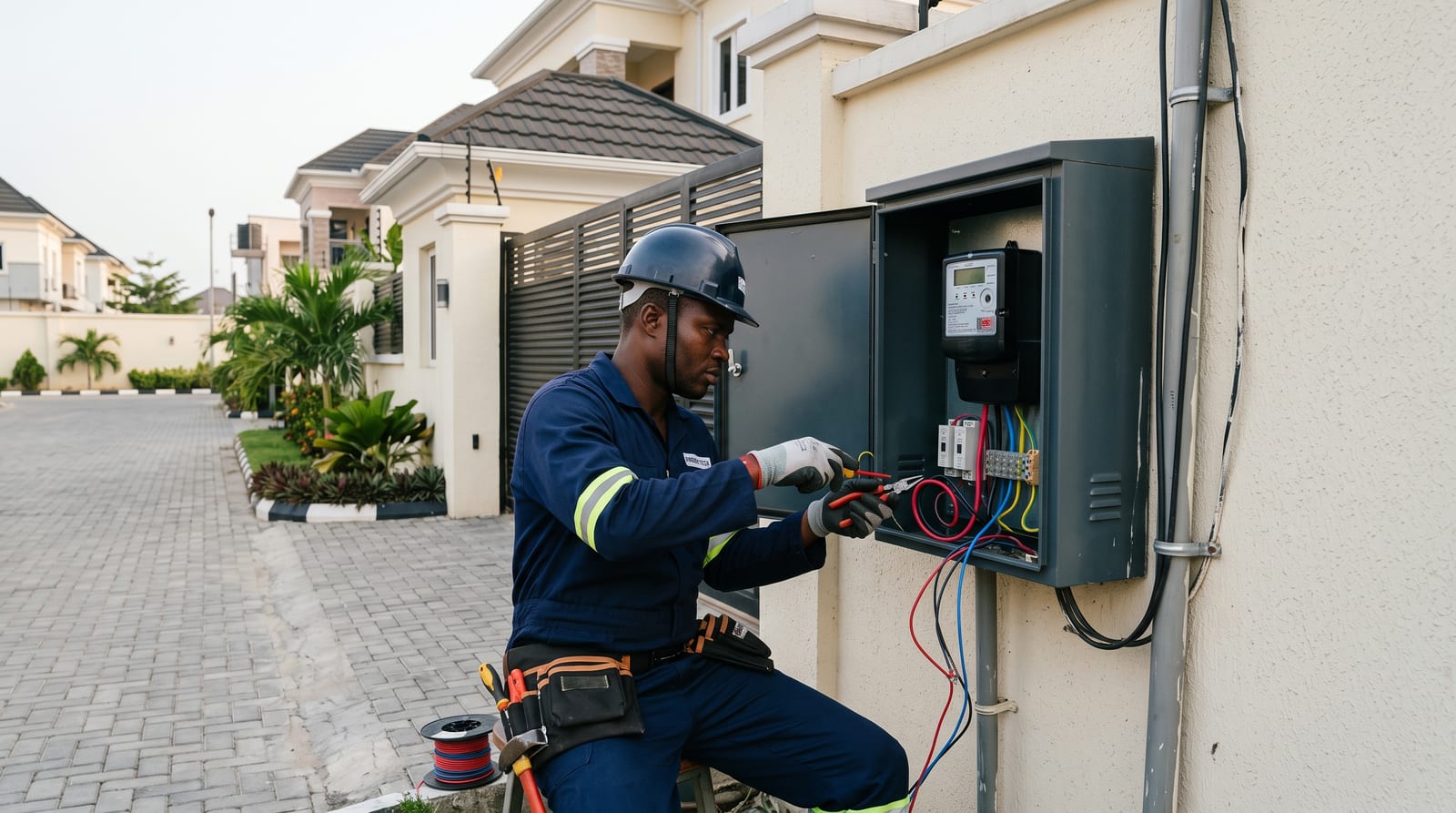 Technician installing a prepaid meter in a secure enclosure
How do you roll out metering without disputes?
Roll out metering in stages, communicate before you install, and run a shadow billing period so people see their measured consumption before it affects their bill.
A practical rollout sequence
- Audit the network: map every feeder, substation, building and unit; record existing meters and their condition.
- Design the architecture and communications, and specify meters and enclosures.
- Meter the top levels first (generation, feeders, substations) to establish losses before touching residents.
- Announce the programme with the tariff method, timeline and how to query a reading.
- Install building and unit meters area by area, with photographs and seal numbers recorded at each installation.
- Shadow bill for one to two cycles: show measured consumption and the bill it would produce, while charging the old way.
- Switch over, with a clear query and dispute process and a named contact.
What makes residents trust the numbers
Accurate, certified meters; readings they can see; a published tariff method; and a fast process for testing a meter they doubt. Test a disputed meter in the resident's presence and share the result.
What operators gain
Measured billing, lower losses, lower peak demand, better data for sizing the next generator, and fewer arguments. When the power plant runs on fuel that costs hundreds of naira per kWh, the metering system usually pays for itself through losses found and energy recovered.
Gotchas
Metering homes before the feeders
Without upstream meters, you cannot measure losses. Meter from the top down.
Oversized current transformers
A CT sized for a future load reads inaccurately at today's lower load.
Cellular meters in weak-signal areas
Readings that fail to arrive become estimates again. Survey signal before choosing communications.
Switching straight to measured bills
Skipping shadow billing turns every surprise into a dispute.
Forgetting the regulatory question
Selling power to residents can bring licensing obligations. Settle the route before setting tariffs.
Key takeaways
- Estates and campuses must meter their own internal networks; national metering programmes stop at the DisCo bulk meter.
- Metering at generation, feeder and consumer levels exposes losses by area.
- CT-operated meters suit large loads; prepaid split meters suit homes and hostels; all revenue meters should be NEMSA-certified.
- A two-part tariff with a published method recovers costs and earns residents' trust.
- Shadow billing before switchover turns metering from a dispute into an agreement.
Frequently asked questions
Can an estate install its own prepaid meters? Yes, on its own internal network behind the bulk supply point, using NEMSA-certified meters. If the estate sells power commercially, check the licensing position with the relevant regulator.
How much can smart metering reduce losses? It depends on the starting point. Metering does not reduce losses itself; it shows where they are, so they can be fixed. Sites with no metering often find significant commercial losses in the first months.
What is the difference between AMI and prepaid metering? Prepaid is a billing method. AMI is the communications and data system. A prepaid meter can be part of an AMI system, which allows remote reading, tamper alerts and remote token loading.
Do we need metering if we already have a generator log book? Yes. A log book records generator hours and fuel; it cannot tell you which building used the energy or where it was lost.
Who maintains the meters after installation? The network owner or its contractor. Lobcom provides maintenance contracts, staff training and technical support for metering systems.
Related reading
- How to Build an Independent Power Project (IPP) in Nigeria
- Captive, Embedded or Mini-Grid? Which NERC Licence or Permit Your Facility Needs
- Power Factor Correction: How Nigerian Maximum Demand Customers Cut Bills
Still billing by estimate? Lobcom maps your network, measures your losses and designs a metering system from plant to prepaid meter, then installs, calibrates and supports it. Book a metering audit.
Sources
- Vanguard: 4.85m customers still unmetered
- ThisDay: 4.8m customers remain unmetered as penetration climbs to 61.5%
- Tribune: 5.36 million customers still unmetered
- The Pinnacle: Over 5 million Nigerians still without meters
- The Frontier: Diesel crosses ₦2,000/litre
- BusinessDay: NERC, SERCs and the regulatory turf war
- Opaindex: Band A tariff