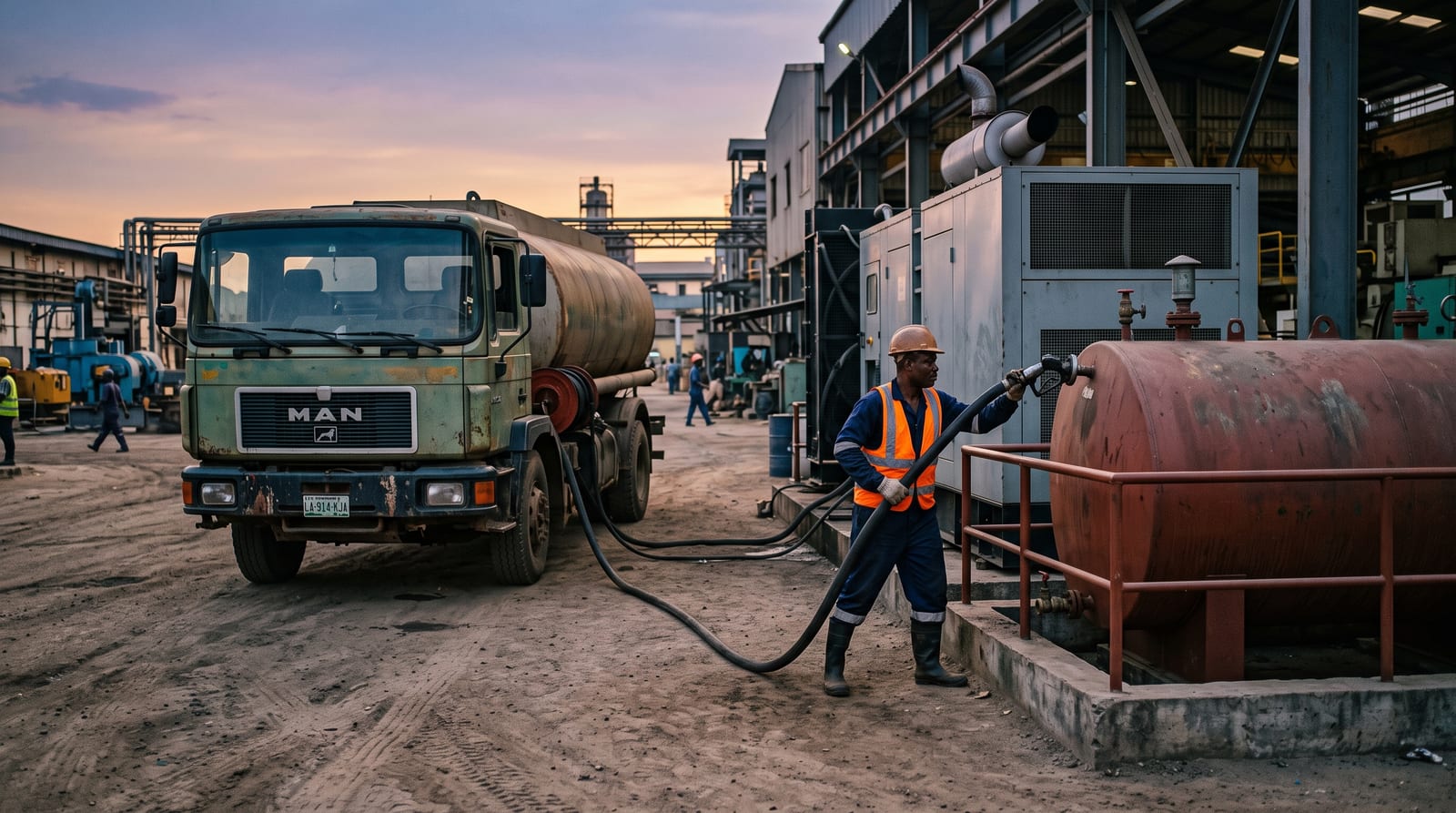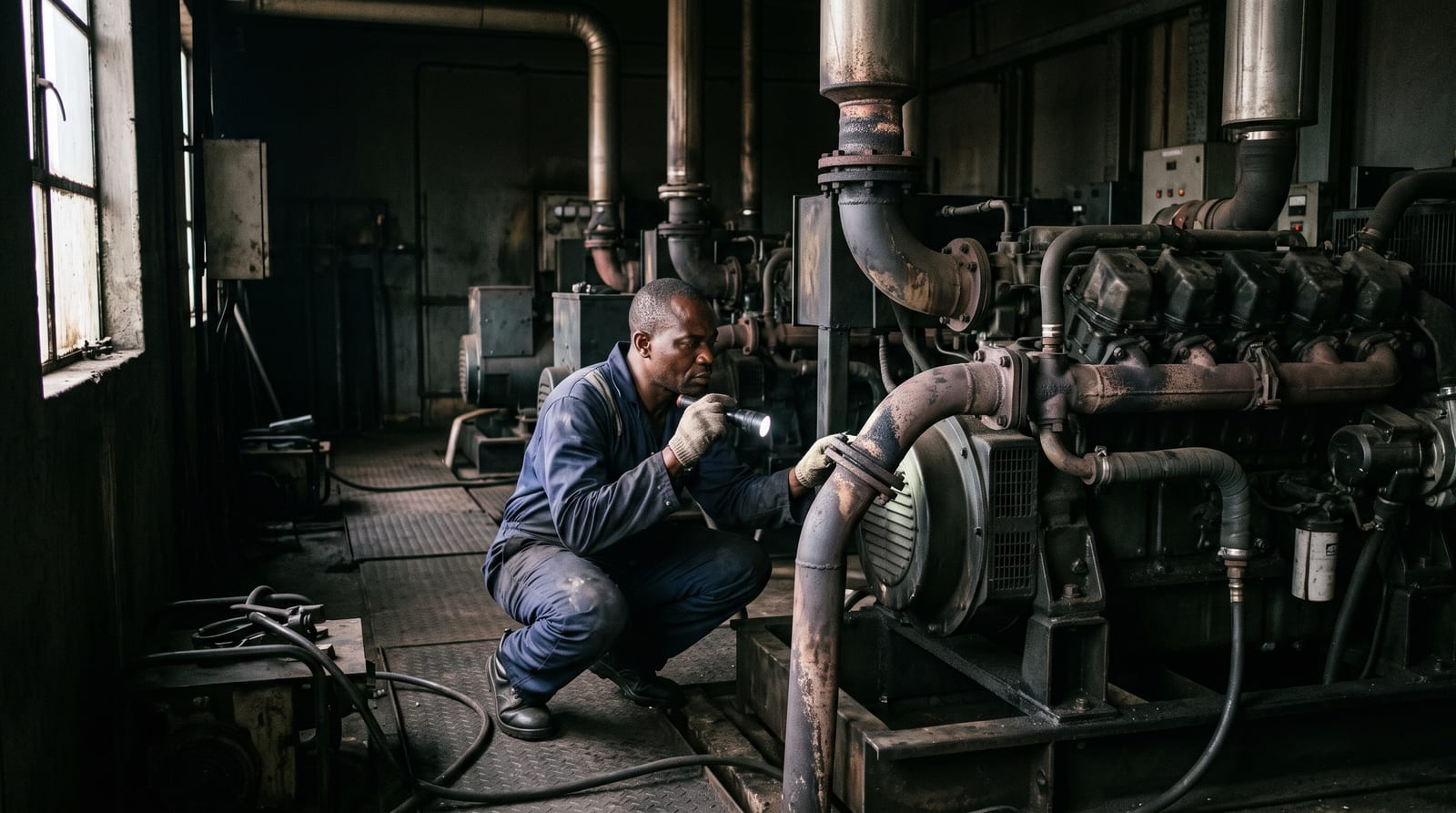
At ₦2,100 a litre, every 0.01 litres per kWh your generators waste costs a factory using 520,000 kWh a month about ₦10.9 million a month.
That is 5,200 litres, gone. Not stolen from a tank you can see, but burned in engines working harder than they need to, or lost somewhere between the tanker and the injector.
Most Nigerian businesses treat diesel as a price problem: diesel is expensive, so the bill is high. Diesel is expensive. It crossed ₦2,000 a litre in Lagos and Ogun in September 2026, up from a pre-crisis level of about ₦900 (The Frontier). But inside almost every generator room we walk into, part of the bill is not a price problem. It is an efficiency problem, and efficiency problems can be fixed without waiting for the market.
Here are the seven leaks we find most often, how to spot each one, and what to do about it.
First: know your number
Everything below depends on one figure: litres per kWh.
Litres per kWh = litres of diesel consumed ÷ kWh generated, over the same period.
- Litres: from fuel delivery records and tank dips, or better, from a fuel flow meter.
- kWh: from the generator controller or a kWh meter on the generator output.
Published ranges for diesel generators sit around 0.28–0.40 litres per kWh at about 75 percent load (Metric Suite). Well-loaded, well-maintained industrial sets can reach the lower end.
If you cannot calculate this number today, that is Leak Zero: you can't manage what you don't measure.
Leak 1: Underloading
What it is. A generator running at a small fraction of its rating.
Why it burns diesel. An engine uses a large amount of fuel just to keep itself turning, whatever the load. At light load that fixed consumption is spread over very few kWh, so litres per kWh climbs steeply. Your manufacturer's fuel curve will show it: consumption per kWh at 25 percent load is much worse than at 75 percent.
Light loading also causes wet stacking: unburned fuel and soot build up in the exhaust, because the engine never gets hot enough to burn cleanly. You see black oily residue at exhaust joints and heavy smoke when load is applied. Wet stacking accelerates wear and makes fuel consumption worse still.
How to spot it. Compare average kW with rated kW on the controller. If a 1,000kVA set spends most of its hours below about 30–40 percent load, it is underloaded.
The fix. Right-size. Run a smaller set for night and weekend base load, and bring larger sets in for production. On new installations, choose several modular units instead of one large one.
Leak 2: Too many sets online
What it is. Running three generators in parallel when two could carry the load.
Why it burns diesel. Load is shared across all running sets, so each one runs lightly loaded, which is Leak 1 multiplied. Operators often keep an extra set running "just in case", because nobody trusts the load-management system, or because there is not one.
How to spot it. Look at each set's load in the controller log. If all running sets sit at low load for long periods, you have one too many online.
The fix. Automatic load-demand control: the synchronising controller starts and stops sets according to total load, with a safe margin for sudden steps. Keep spinning reserve at a defined level, not "whatever the operator feels like."
Leak 3: Poor power factor
What it is. Load that draws more current (kVA) than useful power (kW) requires.
Why it burns diesel. Generators are usually rated in kVA at 0.8 power factor. If your load runs at 0.7, the alternator hits its current limit before the engine reaches its power limit, and you need an extra set online to carry the kVA. That extra set drags every running set into lighter loading (Leak 2).
How to spot it. Read the power factor on each generator controller during production. Consistently below 0.8 is a warning; below 0.75 is a problem.
The fix. Power factor correction, designed for generator operation so it never pushes the power factor leading at light load. See our guide Power Factor Correction.
Leak 4: Fuel that never reaches the engine
What it is. Diesel lost between delivery and combustion: short deliveries, pilferage, leaks and contamination.
Why it burns money. Every litre lost is paid for at ₦2,100 and produces no kWh at all.
Where it disappears:
- Short deliveries: tankers delivering less than invoiced, with dips taken badly or not at all.
- Pilferage: diesel is easy to resell, and tanks with poor security invite it.
- Leaks: weeping fittings, day-tank overflows, return lines, corroded tanks.
- Contamination: water and microbial growth in storage tanks block filters, damage injectors and force fuel to be drained and discarded.
How to spot it. Compare litres delivered, litres dipped and litres consumed (from flow meters or from kWh × expected litres per kWh). A gap you cannot explain is a leak, whatever its cause.
The fix. Calibrated tank level sensors, fuel flow meters on engine supply and return, delivery verification against meters rather than dips, locked fills and vents, regular water draining and tank cleaning, and a monthly fuel reconciliation signed by someone who does not run the generator room.
Leak 5: Bad changeover and idle running
What it is. Generators running when they don't need to.
Where it happens:
- The grid returns but the generator keeps running because the automatic transfer switch is set to a long return delay, or because the changeover is manual and the operator is elsewhere.
- Generators idling for long periods after a stop command, beyond the manufacturer's recommended cool-down.
- Sets started "to warm up" long before load is transferred.
- Test runs that stretch far beyond what the test requires.
How to spot it. Compare the generator hour meter with the grid outage record. If generator hours exceed outage hours plus sensible test and cool-down time, the difference is idle running.
The fix. Review and set transfer switch timers deliberately: a return delay long enough to confirm the grid is stable, and no longer. Set cool-down to the manufacturer's recommendation. Log every manual start with a reason. For sites with frequent changeover, which is most Nigerian sites, this leak can be significant.
Leak 6: Neglected maintenance
What it is. An engine in poor condition burning more fuel per kWh.
The usual culprits:
- Clogged air filters: the engine struggles for air and burns fuel inefficiently.
- Worn or dirty injectors: poor atomisation, incomplete combustion, black smoke.
- Contaminated fuel filters: fuel starvation and uneven running.
- Cooling problems: overheating derates the engine and forces sets to share load unevenly.
- Turbocharger wear: less air, less efficient combustion.
How to spot it. Rising litres per kWh at similar load, black smoke, hunting speed, rising exhaust temperatures, and maintenance records that show services done late or not at all.
The fix. Maintenance tied to engine hours, as the manufacturer specifies, with records kept. Track litres per kWh for each set monthly: a set whose figure is creeping up is telling you it needs attention before it fails.
Leak 7: No monitoring
What it is. Running a power plant on memory and paper logs.
Why it burns diesel. Every leak above is invisible without data. Underloading, too many sets, poor power factor, fuel losses, idle running and worn engines all show up clearly in data, and all of them hide in a log book.
The fix. A monitoring system that records, for every set: load (kW and kVA), power factor, running hours, kWh generated, fuel consumed and alarms, plus grid supply status and tank levels. Set monthly reports and alerts:
- Litres per kWh per set.
- Hours at light load.
- Generator hours versus grid outage hours.
- Fuel delivered versus fuel consumed.
Lobcom installs data acquisition and remote performance monitoring on generator plants for exactly this reason: once the numbers are visible, the leaks start closing.
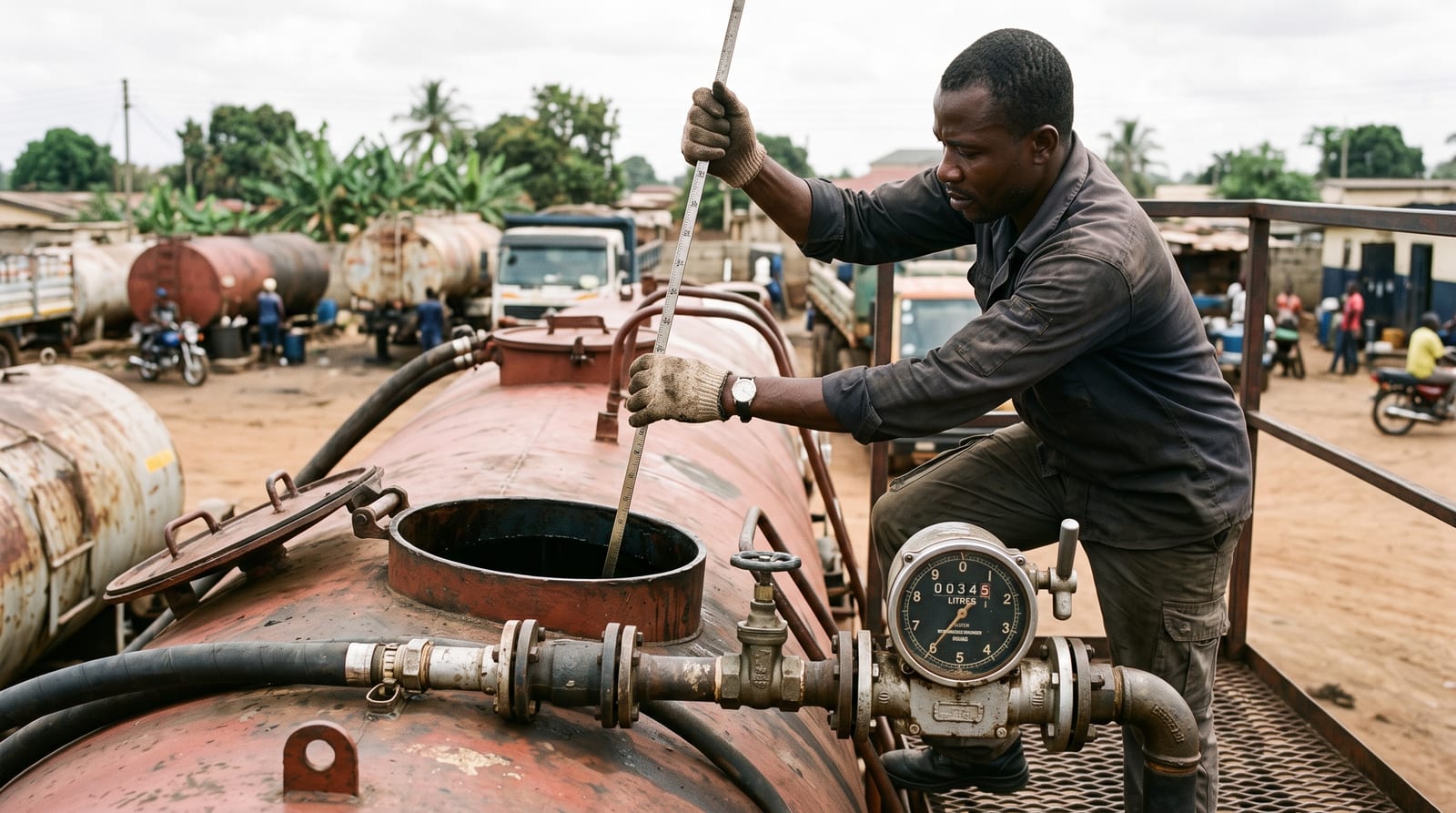 Technician dipping a diesel storage tank beside a fuel flow meter
How much are your leaks worth?
Here is the arithmetic, so you can size the prize. Inputs are labelled.
- Monthly generator energy: 520,000 kWh (assumption: a 1MW average load, 20 hours a day, 26 days).
- Diesel price: ₦2,100 per litre (September 2026, Lagos/Ogun).
| Improvement in litres per kWh | Litres saved per month | Naira saved per month |
|---|---|---|
| 0.01 | 5,200 | ₦10.9 million |
| 0.03 | 15,600 | ₦32.8 million |
| 0.05 | 26,000 | ₦54.6 million |
Now use your own figures. If your site generates 100,000 kWh a month, a 0.03 L/kWh improvement is worth 3,000 litres, or about ₦6.3 million, every month.
Why this matters now
MAN says power costs now exceed 50 percent of members' production costs, and that spending on alternative power in the first half of 2026 had already matched the whole of 2025 (The Frontier). The Frontier also reported that manufacturers warn rising energy costs could force more firms to cut production hours, cut jobs or shut down.
You can't control the diesel price. You can control how many kWh you get out of every litre.
And fixing the leaks is also the right first step before any bigger investment. A gas plant, a solar array or a cluster IPP should be sized for your real, efficient load, not for a load inflated by waste. See Diesel Hit ₦2,100/L for when a bigger move makes sense.
A 30-day plan to close the leaks
You don't need a capital budget to start. You need a month and a named owner.
Week 1: Establish the baseline
Record, for each generator, running hours, kWh generated and fuel consumed. Dip every tank at the same time each day and log deliveries against invoices. Download controller event logs and note every grid outage and return. At the end of the week, calculate litres per kWh for each set.
Week 2: Fix what costs nothing
Review transfer switch return delays and cool-down timers, and set them deliberately. Write a rule for how many sets run at each load level, and brief every operator on it. Stop warm-up runs that serve no purpose. Secure tank fills and vents, and move delivery verification to someone outside the generator room.
Week 3: Fix what costs little
Replace overdue air and fuel filters. Drain water from tanks. Repair visible leaks at fittings and return lines. Book injector and turbocharger checks for any set whose litres per kWh is clearly worse than its siblings. Take power factor readings during production and, if they are low, commission a power quality survey.
Week 4: Measure again and decide
Repeat the week 1 measurements and compare. The difference, multiplied by your diesel price, is what the first three weeks were worth. Then decide on the investments the data now justifies: fuel flow meters, a monitoring system, load-demand control, power factor correction, or right-sizing with a smaller night-time set.
Keep it going
Make litres per kWh a monthly management number with a target, and review it with the same seriousness as sales or production. Leaks that were closed have a habit of reopening when nobody is watching.
The generator-room checklist
Print this. Walk your plant room this week.
- Do we know litres per kWh for each set, this month?
- Does any set spend long hours below 40 percent load?
- Are more sets online than the load needs?
- Is power factor on each set at or above 0.8 during production?
- Do fuel delivered, dipped and consumed reconcile?
- Are tanks secured, drained of water and free of leaks?
- Do generator hours match grid outage hours plus reasonable test and cool-down time?
- Are transfer switch return and cool-down timers set deliberately?
- Is maintenance up to date against engine hours?
- Is there a monthly report someone outside the plant room reads?
Every "no" is a leak with a naira value.
Gotchas
Blaming the price for everything
Price explains part of the bill. Litres per kWh explains the rest.
Reconciling fuel with the person who runs the plant room
Independent sign-off closes gaps that self-reporting leaves open.
Keeping an extra set online "for safety"
Spinning reserve belongs in a controller setting, not in an operator's habit.
Measuring monthly totals only
Monthly litres hide which set, which shift and which week is leaking. Measure per set.
Key takeaways
- Litres per kWh is the one number that separates diesel price from diesel waste.
- Underloading, too many sets online and poor power factor all push generators into inefficient light-load running.
- Fuel losses, idle running and neglected maintenance add cost without adding kWh.
- Without monitoring, every leak stays invisible; with it, most can be fixed without new capital.
- At ₦2,100 a litre, a 0.01 L/kWh improvement is worth about ₦10.9 million a month for a site generating 520,000 kWh.
FAQs
What is a good litres-per-kWh figure for a diesel generator? Around 0.28–0.40 at roughly 75 percent load is the published range; well-loaded, well-maintained industrial sets reach the lower end.
What is wet stacking? Unburned fuel and soot accumulating in the exhaust of a lightly loaded diesel engine. It wastes fuel and accelerates wear.
Can monitoring really pay for itself? On a busy generator plant, finding even one leak (idle running, a short delivery pattern, an underloaded set) usually covers its cost quickly. The table above shows why.
Should we switch to gas instead? Possibly, but fix the leaks first so that any new plant is sized for your real, efficient load.
Find your leaks. Lobcom's generator efficiency audit measures load, power factor, fuel flow and running hours on each set, reconciles your fuel records, and gives you a ranked list of leaks with a naira value on each. Book your audit.