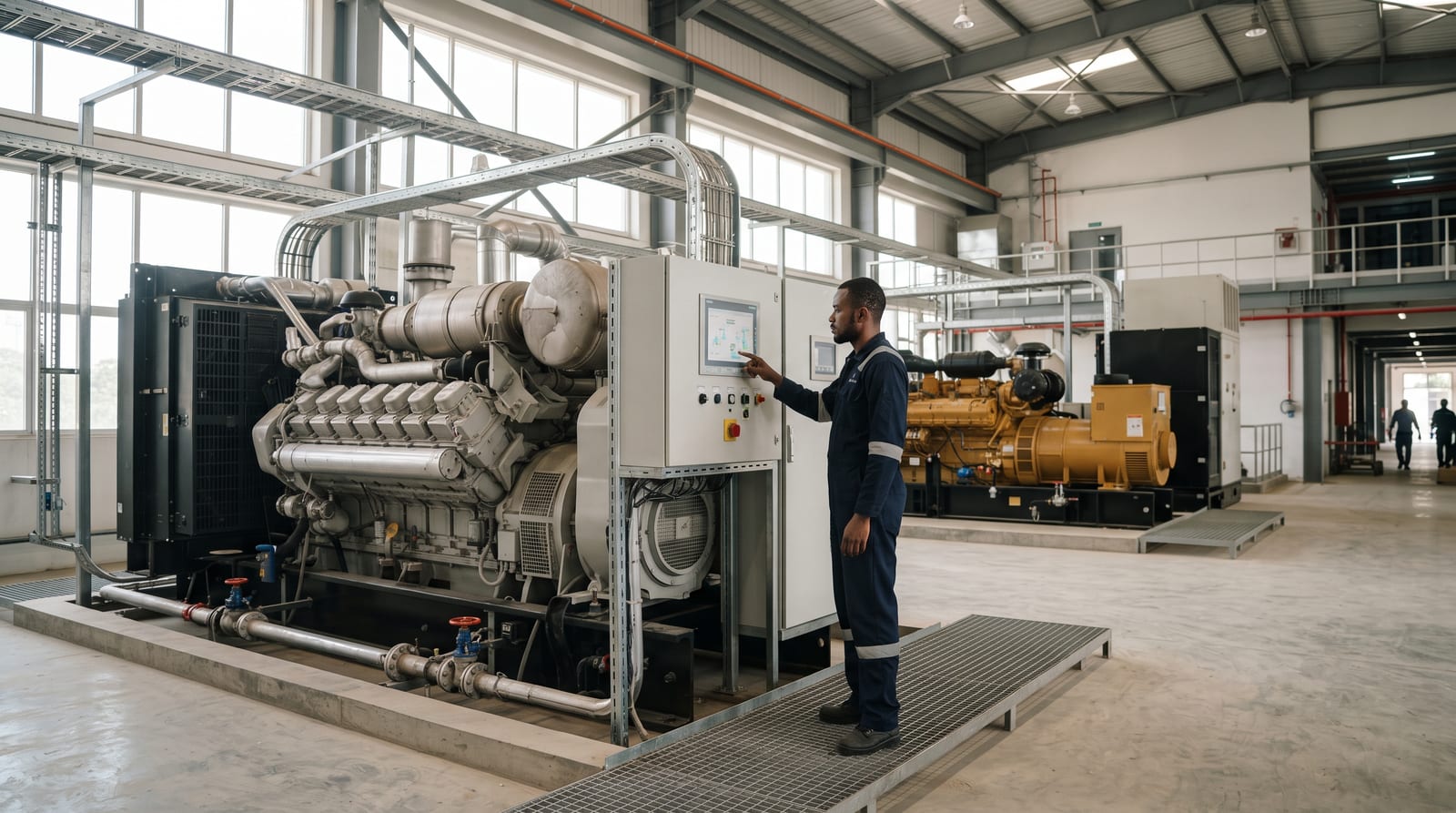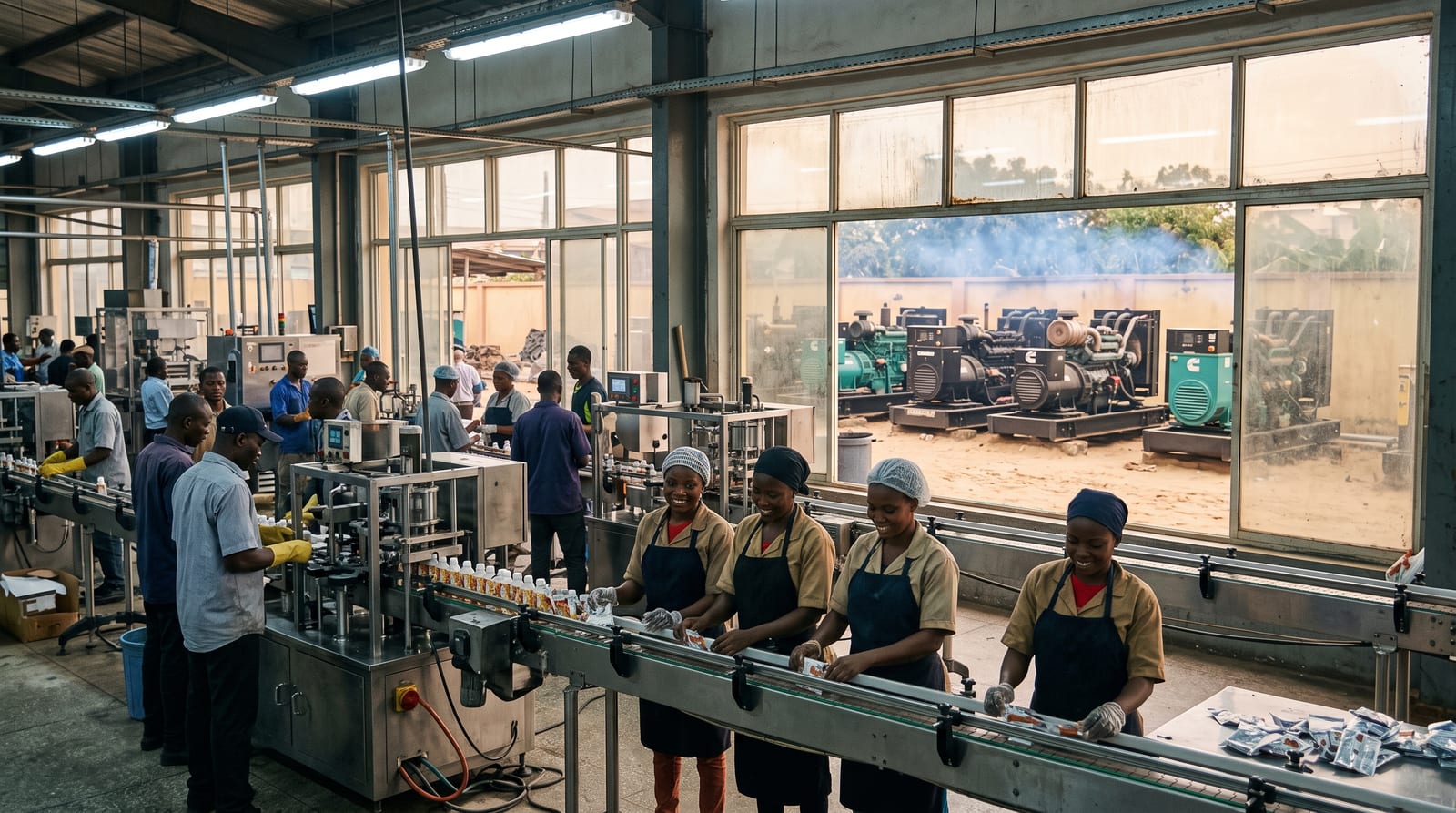
Every month, a Nigerian factory on Band A pays two power bills.
The first comes from the DisCo, at ₦209.5 per kWh (Opaindex), the premium rate for a promise of at least 20 hours of supply a day.
The second arrives as diesel invoices, at around ₦2,100 a litre in Lagos and Ogun this month (The Frontier), for every hour the first bill's promise isn't kept.
Most factories track both bills. Very few add them together and divide by the kilowatt-hours they actually used. When you do, you get the one number that tells you what power really costs your business: your blended cost per kWh.
For many factories, that number is roughly double what they think.
The promise and the reality
Band A is a service-based tariff: you pay more because you are promised more hours.
The reality in 2025–2026:
- MAN says average daily grid supply to its members fell from 16.7 hours in the first half of 2025 to 13.1 hours in the second half (Africa Business Insight).
- Grid plant availability was 31 percent in April 2026 (EBC Financial Group).
- NERC had to order compensation credits for Band A customers after supply shortfalls in February and March 2026 (see our piece Band A Promised You 20 Hours).
The gap between 20 promised hours and roughly 13 delivered hours is filled with diesel.
Your two bills, in one example
Here is an illustration. Every input is a labelled assumption; replace them with yours.
The factory:
- Average load: 500kW, running 24 hours a day (assumption)
- Daily energy: 12,000 kWh
- Grid: Band A at ₦209.5/kWh
- Diesel: ₦2,100 a litre at 0.30 litres per kWh, so about ₦630 per kWh in fuel alone (price from The Frontier; consumption is an assumption)
Scenario 1: Band A delivers the promised 20 hours
- Grid: 500kW × 20h = 10,000 kWh × ₦209.5 = ₦2.10 million
- Diesel: 500kW × 4h = 2,000 kWh × ₦630 = ₦1.26 million
- Daily total: ₦3.36 million
- Blended cost: about ₦280 per kWh
Scenario 2: Band A delivers 13 hours (MAN's second-half 2025 average)
- Grid: 500kW × 13h = 6,500 kWh × ₦209.5 = ₦1.36 million
- Diesel: 500kW × 11h = 5,500 kWh × ₦630 = ₦3.47 million
- Daily total: ₦4.83 million
- Blended cost: about ₦402 per kWh
The gap
- Extra cost per day: about ₦1.47 million
- Over 26 working days: about ₦38.3 million a month
- Over a year: about ₦459 million
And that counts fuel only. It leaves out generator maintenance, overhauls, the generators themselves, the fuel storage, the operators, and the diesel that goes missing between the tanker and the engine.
The real cost is worse than the bills
Look at what the grid bill tells you and what it hides.
The grid bill looks almost the same in both scenarios, because you only pay for what you receive. The damage lands entirely in the diesel line, which many finance teams file under "operations" or "fuel" rather than "electricity."
So the management accounts show an electricity cost that looks tolerable, and a fuel cost that looks like somebody else's problem.
Put them on one line and the picture changes. Manufacturers across Nigeria are seeing it:
- MAN says power now takes more than 50 percent of members' production costs, against a maximum of about 10 percent in most other economies (The Frontier).
- Manufacturers in the Amuwo-Odofin industrial cluster told Oriental News they pay ₦180–220 million a month in electricity bills, on top of running alternative power when supply fails (Oriental News).
- The pharmaceutical manufacturers' group of MAN says members spend over 40 percent of revenue on electricity and alternative generation (Independent).
Kamar Bakrin of the National Sugar Development Council put it bluntly: "every factory in Nigeria is running a second, unwanted business as a private power station" (Independent).
The insight: manage the blended cost, not two bills
The fix starts with a reporting change, not an engineering one.
Blended cost per kWh = (grid bill + diesel cost + generator O&M) ÷ total kWh consumed
Track it every month. Put it in front of the board. Make one person responsible for it.
The moment you do, three things become obvious:
- Every hour of lost grid supply has a naira value. In our example, each hour switched from grid to diesel costs about ₦210,000 more (500kWh × (₦630 − ₦209.5)).
- Diesel efficiency is an electricity issue. A generator burning 0.35 litres per kWh instead of 0.30 adds ₦105 to every diesel kWh.
- Investments compete on one yardstick. A solar array, a gas plant, power factor correction and a better changeover can all be compared on how much each cuts the blended cost.
Where to find each number on your own site
The example above is only useful once you replace it with your own figures. Here is where each one lives.
Grid kWh and grid cost
Your DisCo bill shows energy billed and the amount charged. If you are prepaid, your vending history shows naira spent; divide by ₦209.5 to estimate kWh, or read the meter's cumulative register at the start and end of the month. MD customers usually have a monthly bill that shows kWh and maximum demand directly.
Grid supply hours
This is the number most factories guess. Your automatic transfer switch or generator controller logs every mains-fail and mains-return event; download the event log. If you have neither, ask the changeover operator to keep a written log for one month. Better still, install a supply-monitoring meter on the grid incomer, which records every interruption to the second and totals the hours for you.
Generator kWh
Modern generator controllers show cumulative kWh. If yours only show running hours, multiply hours by average kW from the controller's load display as a rough estimate, and plan to add a kWh meter to each generator output.
Diesel litres and cost
Delivery invoices give litres bought and the price. Tank dips at the start and end of the month adjust for stock. The difference between litres bought and litres in stock is litres consumed, assuming nothing was lost along the way (and the gap between that figure and what the engines should have used is itself worth investigating).
Generator operation and maintenance
Pull service invoices, spare parts, lubricants, filters and any overhaul costs for the month, plus the wage cost of whoever runs the generator room. Spread major overhauls across the months they cover.
Putting it together
Once you have all six numbers for one month, the blended cost is a single division. Do it for three consecutive months before drawing conclusions, because one month can be distorted by a grid collapse, a festive shutdown or a large fuel delivery.
What if you are not on Band A?
The same arithmetic applies on any band. Lower bands pay a lower, partly subsidised tariff for fewer guaranteed hours, so the grid share of the bill is cheaper but the diesel share is usually larger. The blended cost is what lets you compare your band's real value with a move to a different band, or with your own generation.
Five ways to stop paying twice
In rough order from cheapest to biggest.
1. Claim what you're owed, and log your hours
If you are on Band A and do not get your hours, NERC has shown it will order compensation. But you can only argue about what you can prove. Put a supply-monitoring meter on your grid incomer. It records every outage to the second and gives you a monthly supply-hours report. See Band A Promised You 20 Hours.
2. Stop the diesel leaks
Before you spend on new generation, make the existing generators efficient. Underloading, too many sets online, poor changeover settings, missing fuel metering and neglected maintenance all push up litres per kWh. See our piece The Hidden Leak: 7 Things in Your Generator Room Burning Diesel Right Now.
3. Fix power factor and load
Correcting power factor can let you carry the same load on fewer generators, each running at a more efficient point. Scheduling heavy loads (large compressors, furnaces, batch processes) into grid hours cuts diesel hours directly. See our guide Power Factor Correction.
4. Put solar on the daytime load
Solar displaces the most expensive kilowatt-hours first: diesel during daytime outages. For systems of 50kWp–1.5MWp, NERC's Net Billing Regulations 2026 now let you export surplus power for bill credits. See NERC Net Billing Regulations 2026 Explained.
5. Replace diesel as your backup
For factories where grid hours stay low, the biggest move is replacing diesel with gas, either your own captive plant or a shared cluster plant. MAN members have discussed IPPs for industrial clusters (Oriental News), and Delta's gas supplier PowerGas says more than 20 factories in that state already generate their own power from its gas (ThisDay). See Diesel Hit ₦2,100/L for the break-even maths.
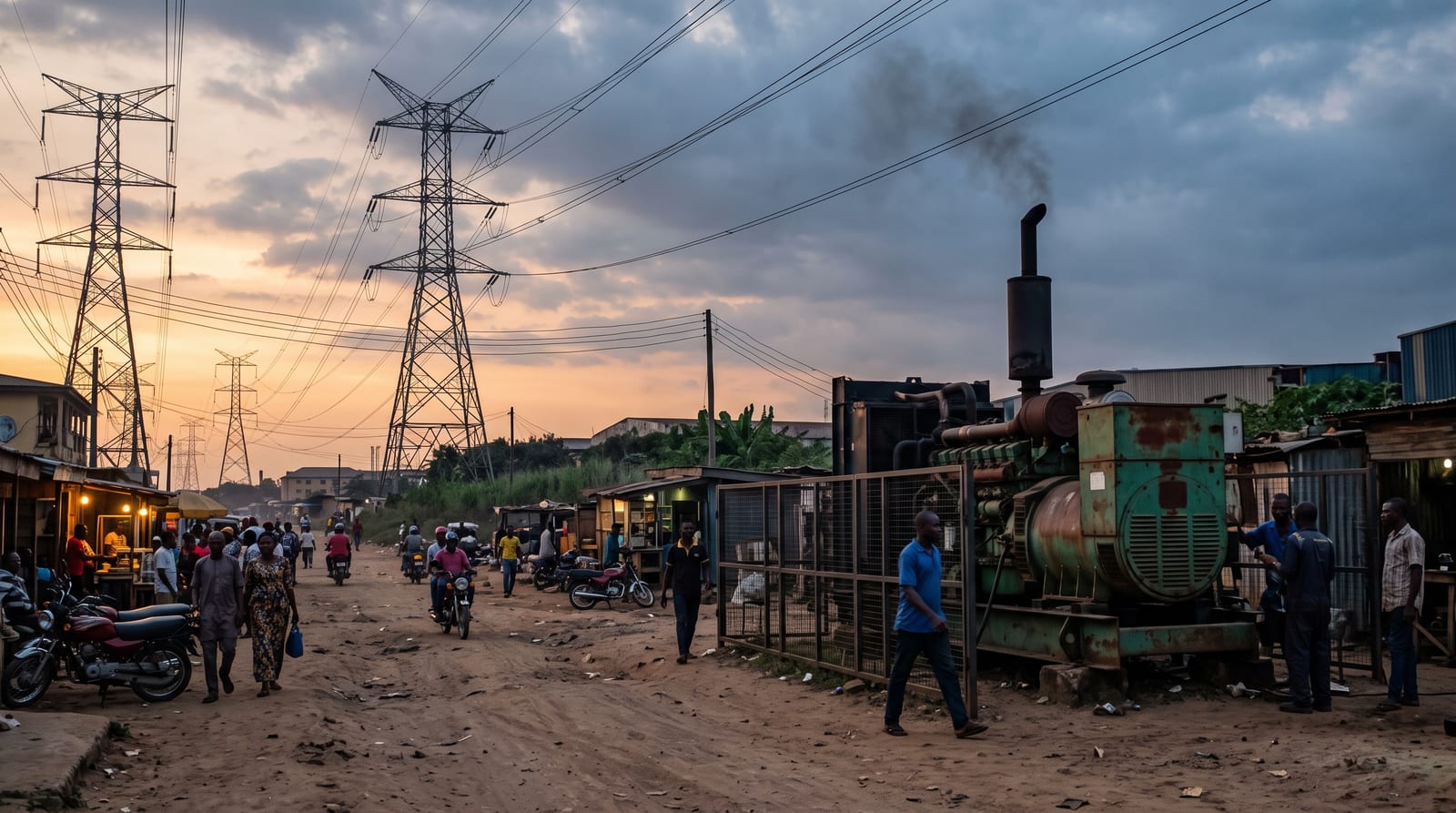 Power lines and a diesel generator side by side at dusk
What this looks like in the boardroom
Here is a one-page power report worth adopting. It fits on a slide:
| Line | This month | Last month | Target |
|---|---|---|---|
| Grid supply hours per day (measured) | 20 | ||
| Grid kWh | |||
| Diesel litres | |||
| Generator kWh | |||
| Litres per kWh (generators) | ≤0.30 | ||
| Grid bill (₦) | |||
| Diesel cost (₦) | |||
| Generator O&M (₦) | |||
| Blended cost per kWh (₦) | |||
| Band A credits claimed (₦) |
When this table has numbers in it, every conversation about power becomes a conversation about money, which is where it belongs.
Three mistakes that keep the double bill alive
Treating each outage as an emergency, not a pattern
When the grid fails, the plant room reacts and production carries on. Nobody records how long the outage lasted or what it cost, so the pattern never reaches management. A month of timestamped supply data usually shows that outages cluster at predictable times of day or week, which lets you schedule heavy loads around them.
Buying generators instead of buying data
When diesel costs rise, the instinct is to buy a bigger or newer generator. Without load and fuel data, the new set is often oversized and underloaded, and the blended cost barely moves. Measure first, then buy.
Waiting for the grid to improve
Reform is under way: net billing, Band A compensation, state electricity markets and new mini-grid rules. But none of it lowers this month's diesel bill. Factories that fix what they control now (hours logged, diesel leaks closed, power factor corrected) will be better placed to use the new rules when they mature.
Why this matters beyond one factory
Bakrin's comparison is stark: industrial power costs a Vietnamese factory about 8 US cents per kWh and a Chinese factory about 10, while a Nigerian factory pays about 15 cents on the grid, "rising towards 30 once the diesel generator takes over" (Independent).
Nigerian factories are not only competing with each other. They are competing with factories that pay a third of their power cost. Paying twice is not a line item; it is a competitiveness problem.
The Power Minister has told manufacturers the era of the diesel generator as their primary power source is ending (BusinessDay). The factories that measure their blended cost now will be the ones ready to act when the numbers justify it.
Gotchas
Filing diesel under "operations"
It hides half your power cost from the people deciding on power investments.
Assuming the grid bill tells the story
You only pay the DisCo for hours delivered. The cost of missing hours lands in the diesel line.
Counting fuel but not maintenance
Generator overhauls, consumables and operators belong in the blended cost.
Relying on estimated supply hours
Measured hours are evidence. Estimates are arguments.
Key takeaways
- Band A factories pay twice: the DisCo bill for hours delivered and diesel for hours missed.
- In a 500kW, 24-hour example, dropping from 20 to 13 grid hours raises the blended cost from about ₦280 to about ₦402 per kWh.
- That shortfall costs roughly ₦38 million a month in extra fuel alone on those assumptions.
- Tracking one blended cost per kWh makes every power decision comparable.
- The fixes range from logging supply hours and stopping diesel leaks to solar, net billing and gas-fired backup.
FAQs
What is a blended cost per kWh? All your power spending (grid bill, diesel, generator maintenance) divided by all the kWh you consumed in the same period.
Should we leave Band A for a cheaper band? Lower bands promise fewer hours at lower, partly subsidised rates. The right answer depends on the hours your feeder actually delivers. Measure first.
Is our diesel consumption normal? Divide litres used by generator kWh. Well-loaded industrial sets typically run around 0.28–0.40 litres per kWh; the lower end is achievable with good loading and maintenance.
Can a group of factories share a power plant? Yes, subject to the right licence and agreements. Cluster plants are being discussed by manufacturers' groups and suit industrial estates.
Find out what your power really costs. Lobcom's blended-cost audit combines your bills, diesel records and a two-week supply log into one number and a ranked list of fixes. Book your audit.
Sources
- Opaindex: Band A tariff
- The Frontier: Diesel crosses ₦2,000/litre
- Africa Business Insight: Manufacturers spend US$930m on alternative power
- EBC Financial Group: Band A credits and net billing
- Oriental News: Manufacturers mull independent power
- Independent: Manufacturers lament rising energy costs
- Independent: Manufacturers spent ₦1.34 trillion in 2025 generating electricity (Bakrin)
- ThisDay: Delta unveils roadmap to unlock 3,000MW
- BusinessDay: End of diesel generator nears for manufacturers